Zoeken in deze blog

vrijdag 16 september 2022

Francisco Esteve: Model ELEC 1989 (with cutaway)


This particular model has been built by master luthier
Manuel Adalid in collaboration with Francisco Esteve.
It is the top of the line electric cutaway guitars in their
collection. All solid woods and acoustic a really
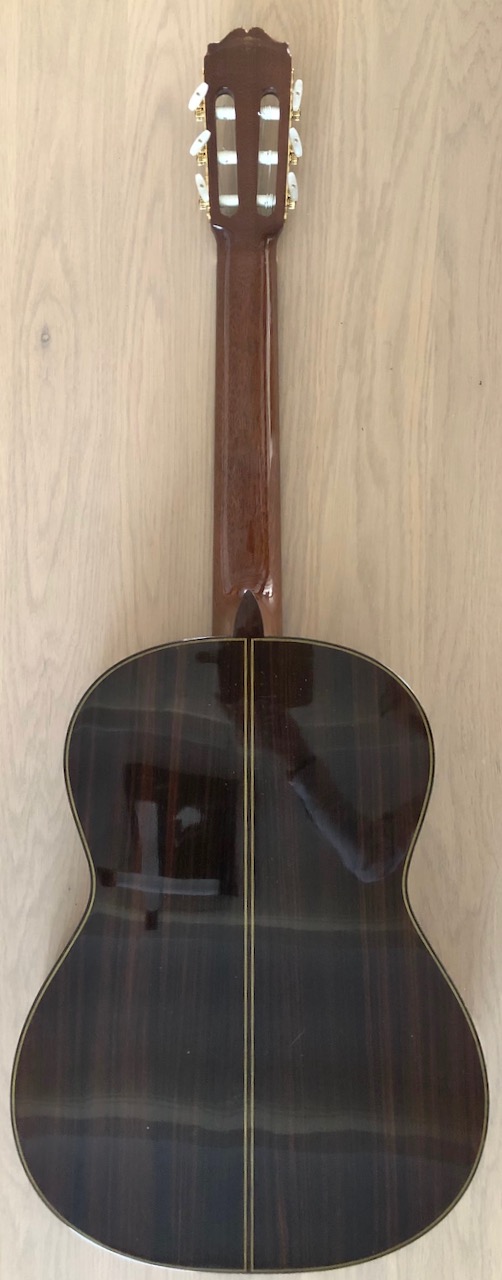
surprising tone. Solid Indian rosewood sides and 
back, a cedar neck that is provided with an ebony 
fingerboard. This is a cedar topped guitar and so is
its' sound. Scale on this guitar is 655 mm. 
Price 1200,- SOLD.


The back of the neck has been reinforced with an ebony
layer. The outer heel on this guitar was still more rounded
as the later examples that also have another bridge.


Not the most expensive Fustero tuners but they work 
surprisingly well. I've had the same ones on an Antonio
Duran Concert guitar so "good company"!


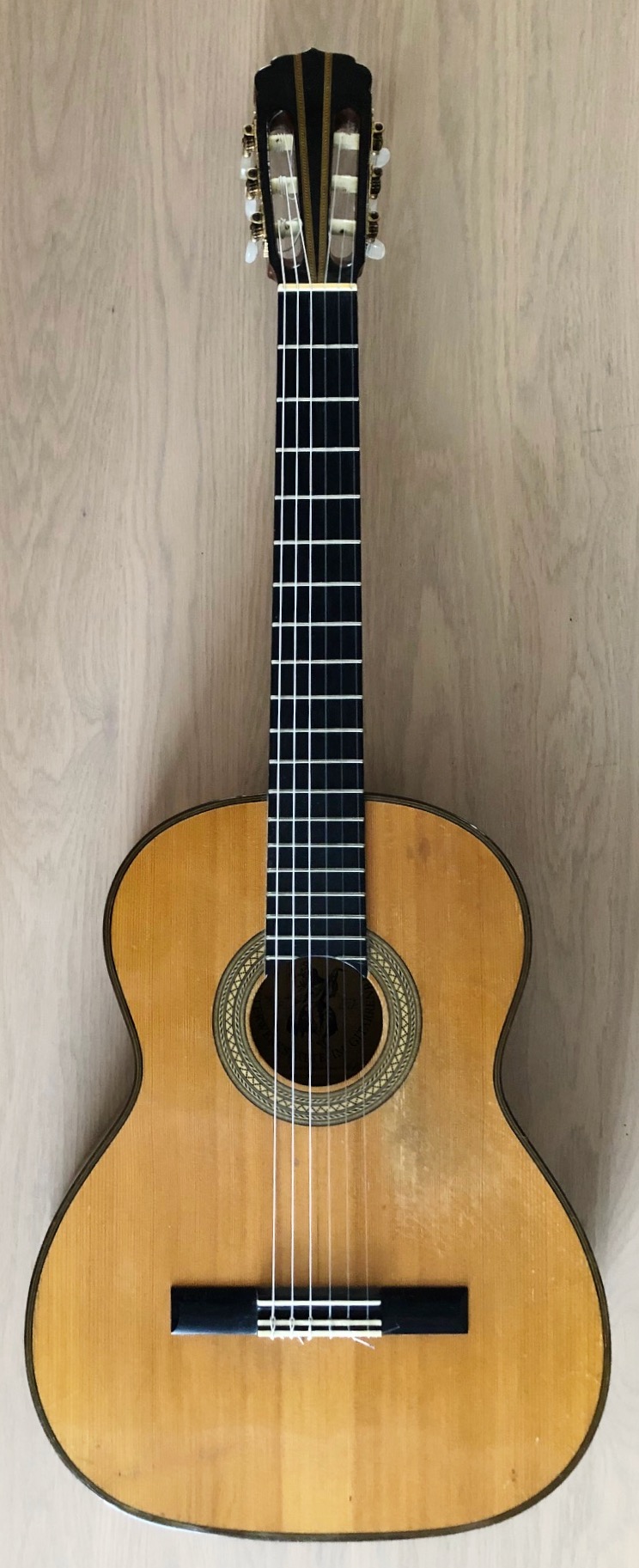
Clearly visible is the ebony fingerboard and the finely
executed binding. For better playability the neck has been
refretted and before that the fingerboard was shaved off a 
bit towards the head in order to get a better angle over the
bridge bone and a better tone and playability!


The later ELEC models have an ebony bridge which is beautiful
but in fact a bit too heavy. On this guitar, that has been imported
in England by the Juan Teijeiro Music Company, the bridge is 
executed out of Brasilian rosewood. Only in small characters
the name of Francisco Esteve has been mentioned on the label
though it clearly says: ELEC and has been dated 1989.
When you order this guitar, the electronics that are OK
will be delivered separately as I wanted to know how this
guitar would sound without the under saddle pick up that 
has a negative influence on the sound to my believe.


Recent development was the adding of a 12 hole bridge which
makes mounting strings much easier and moreover gives a better
angle from the strings over the top gof the bridgebone. And if
you want to know more feel free to contact me. Also after the 
sale I will be ready for you the solve problems on your guitar.
Is the guitar not to your satisfaction for serious reasons 
(hidden shortcomings) you will get your money back.


Of course there are some traces of use here and there 
and people have to know that as well besides other
things such as a not straight soundboard, a neck with 
too much relief, a bridge that might come off, broken
rollers what often happens on older guitars as the
metal in the roller expands and as a result the plastic
surrounding cracks. In this Blog Greatguitarsshop
you can also find all things to inspect when you buy a 
second hand guitar. Here a kind of burn mark is 
detectable on the back of the head. How someone 
is able to cause that remains a question...


The front of the head is in pristine condition and the
new added topnut can be admired here. The small 
damage on the back is only cosmetically.


Want to know more around this brand and in general
about the Valencia made guitars, just check this site:
www.guitarrasvalencia.wordpress.com

donderdag 7 juli 2022

Oscar Teller 8 / P Concert guitar (1971) Oscar Teller 8 / A Concert guitar (1971)


This is an Oscar Teller Classical guitar from 1971. 
One of their highest models then. Fairly well played!
The P in the model number stands for Palissander
(Rosewood) while an A stands for Ahorn (maple) Most 
significant detail is that Mason Williams recorded his 
nr. 1 hit in the United States on a "Cordova" branded 
guitar: "Classical Gas" that came from the Teller factory. 
As Spanish names sold better there for that reason it 
was labelled otherwise.... Price: € 1500,-


OK. The guitar needs some restorations but all in all
it can be done and a lot of things will be more cosmetic:
Some loose bindings, partly lost. It has all been solved.
Scale of this instrument is 650 mm. The own frequency
of the soundbox is G# so 104 Hz.


The label, always with the model, year of manufacture and
production number, visible on the next picture.


And a registration number as is there on this label.
The model 8 / P is still in production and lists for
2850 Euro's. Alas, not exactly the same as the old 
ones. The 10 P Exclusive is the upper model now 
that is on their pricelist for 4.900 Euro's. That model
is provided with Brasilian rosewood back and sides.


The back has some disturbing damage but only in the 
lacquer so it will be no problem to fix that properly.


The same thing counts for the soundboard. No cracks 
but a bit unrespectfully treated by its' former owner.
Most likely this guitar comes from a music institute
were they provided their teachers with a better model
guitar to give their lessons on.


Here the Rubner mounted tuners can be seen. Good quality
but a better fit is needed to have them work more smoothly.


A nicely decorated head, probably inspired by the way
the Japanese luthiers worked at that time and were success-
ful with it. A good cut topnut anyway. The front has been
veneered with an ebony layer.


The Rubner company also made cheap tuners that in fact weren't 
bad at all. These are the more deluxe tuners that match the further
quality of this guitar.


An inner Spanish heel and nice inner woodwork as can be
expected from a German company existing that long. They
were in fact a violin builders family.


The rough treatment not only resulted in various needless
scratches but also a (repaired) crack in one side and an
open crack alongside the gluing surface of back and
sides. Some extra inlay work will be needed.


And what a few hours work will do!


Unfinished yet but the possibly polyurethane lacquer 
has been removed here. A nice piece of wood! And
possibly be able to vibrate in a better way with a 
some layers of a more modest lacquer.


By relaquering the back, head and neck some dings and 
scratches can be cured and these layers are giving the 
guitar a smooth feel again.


A closer look here of the refinished back


The front that hasn't been treated. I left it the way it 
came to me. A guitar may have its' history


These typical inlay in the ebony head layer can be found on 
two high end models from the Oscar Teller company in the
past. Mason Willams plays his number 1 hit "Classical Gas"
together with Deborah Henson Conant (Harp) on this model
guitar. Above all, a very nice musical meeting!


The tuner knobs have been riveted as was usual also
on the Spanish "Fustero" tuners of that time. I recently
got an e-mail from the Rubner company in which they 
claim them not to be from their company. The Schaller
company could be the other option of course.


Oscar Teller 8/A


The first step in restoration of this Oscar Teller 8/A model was
to remove the lacquer over the whole instrument. As the lacquer
showed some craquele and had a lot of dirty and unprotected
bare wood spots that was a necessary move.


The back that already has been cleaned and is showing the
bare wood. It explains the prefix "A" in the model number:
The "A" stands for Ahorn, the German name for Maple.
Maybe a bit more uncommon but maple has some qualities
of its' own. And let us not forget: Antonio de Torres as
well as Vicente Arias, two venerable luthiers of the 19th
century also made concert guitars with maple sides and
back. To these days it still is a choice of luthiers but
the classical players, being quite conservative, are not
that eager to embrace the use of maple as it doesn't reply
to real tradition in wood use for concert guitars.


Biggest problem here was the purling and the soundboard
itself that was already loose at this spot. The purfling simply
was gone already. Luckily I found an old rosette of another
German built guitar that I've kept in storage.


And after several hours of work this is the result. It has 
been composed with a lot of very thin layers and therefore
the only solution is to use some fine veneer blades and 
make layers out of that. Do not glue them together but 
only at the bottom where they are resting.


As the label attests this guitar is coming out of the same year 
(and collection) as the model 8/P presented here above.
These two guitars are coming out of a bigger collection
most likely used for educational purposes. But the teachers
should have been more aware of the quality the guitars
provided here. They were not very prudent so to say....


A close shot where you can determine all those layers.


But the back will be brought back in a like new condition.


As the head had suffered some serious injuries there 
was a need to restore the back. I used the same procedure 
Wolfgang Teller uses for his present 8/P model by using
the same wood as the soundbox to kind of veneer the 
back of the head. I could have used ebony but seeing
the picture here below I'm glad I didn't. I used maple.
On a rosewood guitar Mr. Teller uses rosewood for
the back of the head as can be seen here.


Now there is so much harmony when observing
this guitar from the back though still unfinished on
the left but lacquered on the right. The beautiful
figured maple is there to its' full potentials.


maandag 23 mei 2022

Mass Hirade / Takamine "Master Arte" gitaar: Model 15


Een higher end model dat je niet zo vaak tegenkomt van
deze bouwer / fabrikant. Dat Hirade deze gitaren persoon-
lijk bouwde zal waarschijnlijk niet het geval zijn. Wel
signeerde hij vaak de labels van deze Concert Arte
series. Deze gitaar is gebouwd in 1984, de topjaren voor 
wat betreft Japanse producten: Betaalbaar en kwaliteit.
Vraag gerust naar een prijs.


De gitaar is opgebouwd uit massieve materialen wat van
een topgitaar verwacht mag worden. De later toegepaste
ebben verstevigingsstrip in de hals ontbreekt hier nog.


De hele gitaar laat zorgvuldigheid zien qua bouwken-
merken. En alhoewel Mass Hirade bij Kohno geleerd 
heeft, is diens bovenblad ondersteuning niet gekopieerd.
Een traditionele waaierbracing (7 stuks) is hier toe-
gepast. Indiaas palissander en een scale van 650 mm.
De "eigen frequentie" van de klankkast ligt op A.
In Herz kun je dus zeggen rond de 110 Hz.


Een zorgvuldig gesneden topkam met een breedte van
52 mm. Prima mechanieken die zeer gelijkmatig werken.
Je zou er Fustero's alleen al voor vervangen op je Spaanse
concertgitaar! Verantwoordelijk voor de werking zal
zeker ook de overbrenging zijn: 1 op 18.


Dat daarbij ook de knoppen demontabel zijn, vind ik 
een absolute plus. De ashouders zijn ook niet "uit de
plaat gebogen" zoals dat bij goedkopere mechanieken
doorgaans het geval is.


Verwarring kan ontstaan omdat Takamine later de H15
als model heeft uitgebracht. Kwalitatief gewoon een
mindere gitaar dan deze Hirade. Vreemd is natuurlijk
dat ze het woordje "fifteen" verkeerd geschreven
hebben. Opmerkelijk is verder dat deze duurdere
Hirade niet gesigneerd is terwijl dat met sommige
"lower end models" uit deze reeks wel het geval is.

Voor wat betreft de Takamine serie nummers: Deze
zijn terug te vinden op het hielblok in de gitaar en
de codering is in feite niet erg ingewikkeld: De eerste
twee cijfers (84 hier) geven het bouwjaar aan. Dan
zijn de volgende twee cijfers verantwoordelijk voor 
de maand van fabricage. De 4 cijfers daaropvolgend
geven het zoveelste exemplaar aan in die maand 
gemaakt. Deze manier van dateren heeft Takamine
gevolgd tussen 1962 en 2012 met uitzondering
van de G-series van dit bedrijf,


Het leek wel mode te zijn in Japan om het achterblad van 
een dunne vernislaag te voorzien in de klankkast. We treffen 
dit ook aan bij de Masaru Kohno, Sakurai, Juan Orozco en 
de Tama modellen uit die tijd. Een duidelijke reden daarvoor 
heb ik nooit kunnen vinden. Helderder klankresultaat?


De randinleg lijkt gekopieerd te zijn van de high end 
Kohno gitaren maar gezien de verschillende gitaren die 
af en toe aangetroffen worden zou een derde partij hier 
wel eens verantwoordelijk voor kunnen zijn geweest.


Ook het brugblok is van versiering voorzien, wellicht toch
meer een keuze van de mensen in Azie. Een andere smaak
en soms een beetje "over the top". Model 20 heeft deze
randinleg ook maar is voorzien van Braziliaans palissander
voor de zij en achterkant van de klankkast.


Nog beter te zien is de randinleg op deze foto en je kunt
hem zelfs beter bestuderen door op de foto te klikken.
Opmerkelijk bij dit instrument is de bespeelbaarheid nog
even los van het mooie geluid. Die is erg nauwkeurig
afgesteld. Het geluid is niet vergelijkbaar met de Kohno,
Sakurai en Orozco gitaren die voor de wereldmarkt ge-
produceert zijn. Het geluid is wat sprankelender en
heeft niet dat robuuste wat de eerste 3 hebben.
De andere kant is dat de levendigheid in de toon
een sterk punt is van deze gitaren. Toch lijkt de onder-
steuning van het laag vanuit de laagste frequenties
te komen, een soort van "voelbaar" laag.