Zoeken in deze blog

zondag 22 maart 2020

Gibson LG1 1967: Gebroken kop en de restauratie ervan.


Een erg vervelend gezicht voor gitaristen maar het 
gebeurt nogal eens. Vanwege de schuine plaatsing 
van de kop op de hals zijn met name Gibson gitaren 
vaak het slachtoffer bij het achterover vallen van de 
gitaar .Deze gitaar kwam zo aan bij een koper. Het 
was bekend dat er een kop reparatie aan de gitaar 
verricht was maar hier was voor mij duidelijk te zien 
dat het de oude breuk betrof met vreemd genoeg geen 
lijm residu. De koper kreeg natuurlijk zijn geld terug.
SOLD.


Naast de breuk was er een inzetstuk te zien bij de oude
reparatie wat mij ertoe deed besluiten een heel nieuwe
kop te maken. Hierbij ging ik gebruik maken van het 
feit dat de kop bestaat uit 3 delen die in de lengte aan
elkaar gelijmd worden.


Links is een duidelijk recht stuk te zien dat mij ertoe
uitnodigde dit ook aan de rechterkant te maken. Ver-
volgens kan er een middengedeelte gemaakt worden 
met dezelfde afmetingen als de halsbreedte.


Links is aan de afgebroken kop het indertijd 
geplaatste ontbrekende stuk te zien.


Hier is de grof uitgezaagde kop te zien die nog
"gefine-tuned" moet worden nadat er fineerlagen
op voor en achterkant geplaatst gaan worden.


Het schuine gedeelte wat het toekomstige lijmvlak is,
wordt versterkt door de twee doorlopende gelijmde
"vleugels" van de kop met elk ook weer hun eigen
"lijmvlak". De fineerlagen versterken de boel extra.


Nauwkeurig passend moet dan ook een "hellend"
vlak aangebracht worden op het uiteinde van de hals.


Ik laat hier bewust een stukje lijmvlak over aan de 
achterkant van de kop. De fineerlaag uit een stuk
voor de achterkant wordt hierop vastgelijmd, ervoor
zorg dragend dat de verbinding als geheel nog eens
extra verstevigd wordt.


Links en rechts worden de doorlopende lipjes na verlijming
netjes "weggeschaafd". Ik gebruik daar overigens dremel-
gereedschap voor.


De fineerlaag voor de achterkant loopt keurig 
"in de pas" met de achterkant van de hals.


Voorwaarde is wel dat ook de fineerlaag een afge-
schuind vlak krijgt voor e.e.a. verlijmd gaat worden.
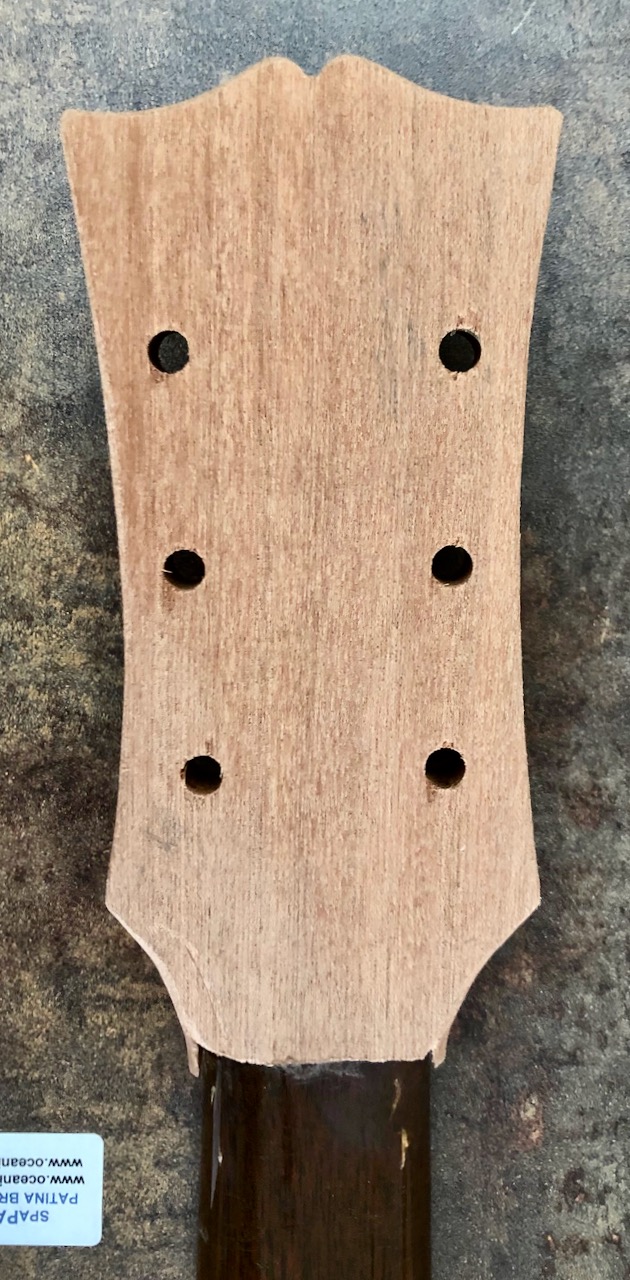

Het ziet er na verlijming ongeveer zo uit.


Voor het uitvlakken van de voorkant gebruik ik een 
mengsel van lijm met het oorspronkelijk zaagsel.
Kleurverschillen maken niet uit want er komt toch
een zwarte plastic fineerlaag op.


De hele hals is hier al weer kaal gemaakt en dan is 
cellulose lak toch altijd nog gemakkelijk verwijderbaar.
Om e.e.a. van een fraaie aanblik te voorzien, zal de
hals en dan met name de kop donkerbruin gebeits gaan 
worden waarna er blanke lak over hals en kop gespoten
wordt. Hiervoor wordt een Alkyd lak gebruikt.


De fineerlaag is aangebracht op de voorkant. De gaten
voor de mechanieken worden nu pas geboord omdat de
fineerlaag even vastgelijmd zit. De toegang tot de truss
rod was al gemaakt natuurlijk. Een nieuw Gibson logo
wordt in een later stadium geplaatst maar wel voor de 
definitieve blanke laklaag. Op de achterkant wordt het
serienummer, wat bij deze gitaar hoort, er weer netjes
ingezet.


De donkere beits maakt de hele reparatie nagenoeg
onzichtbaar. 1 vernislaag ter protectie van de beits
op waterbasis is wel even aangebracht.


De hele hals moest natuurlijk opnieuw gedaan 
worden om e.e.a. in kleur met elkaar te krijgen. 


Na 6 tot 8 lagen is de laklaag weer strak en niet te 
glad bij het bespelen van de gitaar maar zeker ook 
niet "plakkerig".


De kopplaat is hier verlijmd en wordt met de bussen 
van de mechanieken op zijn plaats gehouden.


Een logo dat weliswaar niet gekopieerd is van
het oude jaren zestig logo maar wel kwaliteit
heeft en met wat lagen vernis mooi gelijk met
de bovenplaat kan worden overgespoten.
Deze logo's doen een beetje denken aan de 
latere Martin logo's  zoals ze nu toegepast
worden: Mooi scherp van snit.
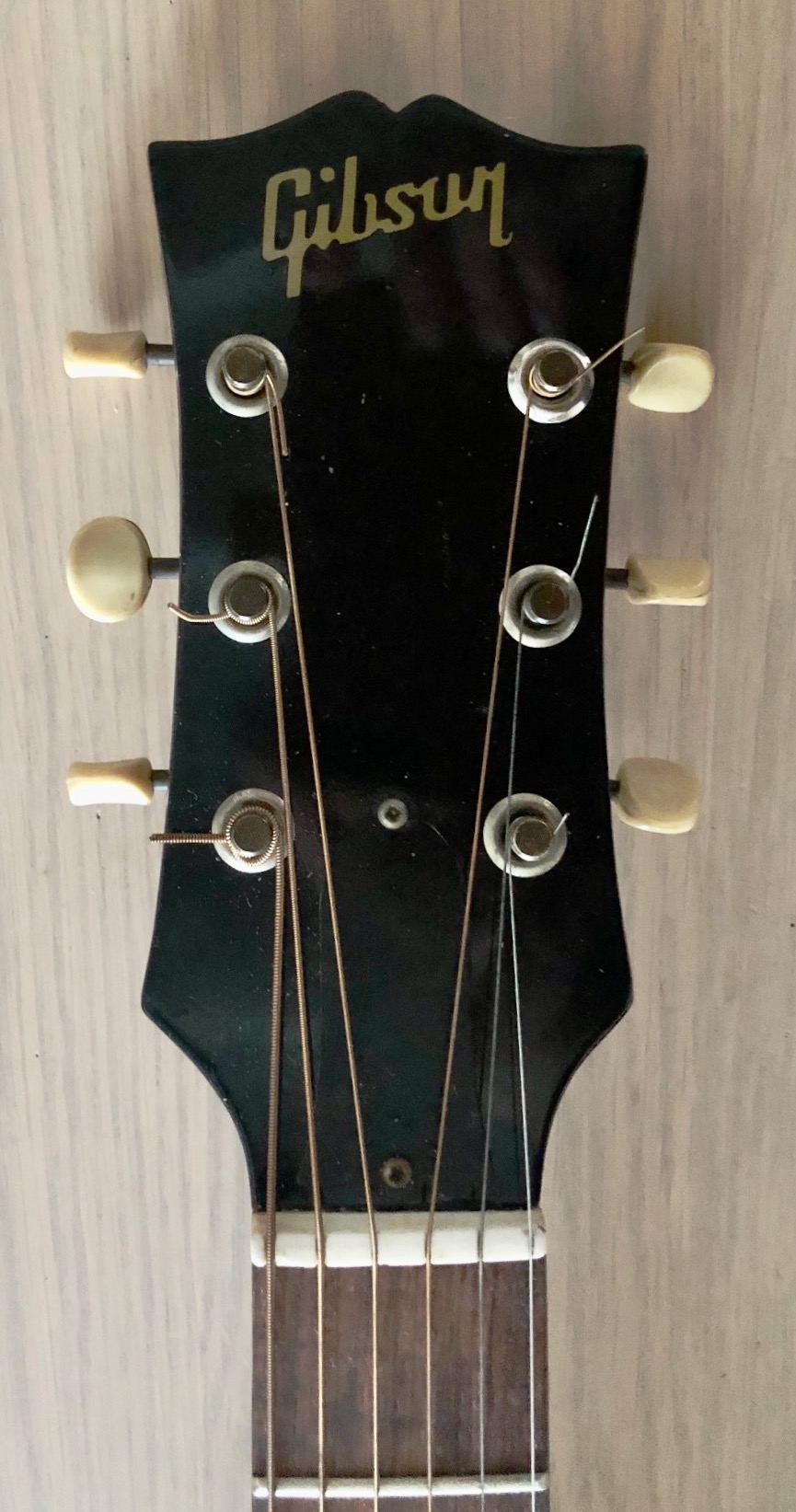

De snaren er weer op en even afwachten wat de trekkracht 
ervan voor de hals betekent. Soms even de trussrod opnieuw
instellen maar dat gebeurt pas na een tijdje.


Het achterblad was al ooit eerder aangepakt.


De kleuren "matchen" goed en alle
schade van vroeger is onzichtbaar.


Dit lijkt op een "achterstevoren" gelijmde kam maar
het originele plastic model dat vervormd was onder de 
spanning van de snaren, zag er identiek uit. Vervangen
door een palissander exemplaar.


Voor wat betreft de "fretwear" hier een foto van de 
onderste frets. Kan nog prima en geeft geen problemen
op dit moment. De frets kunnen overigens met gemak 
een eventuele vlakbeurt hebben.
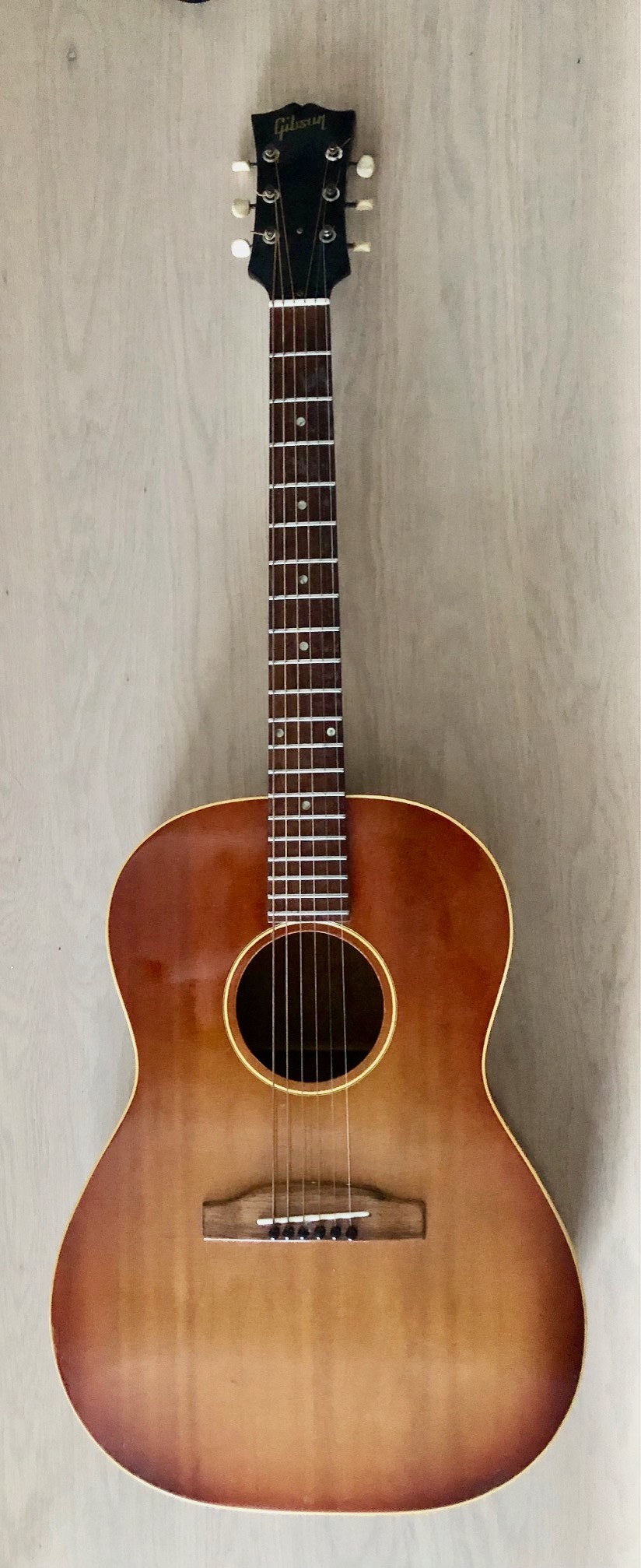

Opvallend bij deze toch wat goedkopere Gibson
is natuurlijk het fijngenerfd bovenblad wat door-
gaans op duurdere exemplaren geplaatst wordt.


Het originele registratienummer is opnieuw ingestanst.


Hals / Kop verbinding is nu weer volkomen
betrouwbaar. Het blijft echter uitkijken bij
Gibson gitaren voor het achterover vallen.


Nog wat extra close ups van de gerepareerde plek.


De mechanieken doen hun dienst nog prima.


Prettig aanvoelende maar wel smalle hals op deze gitaren. 
Het geluid is echter groot: Veel volume met dat door blues 
en rock gitaristen zo gewenste rauwe randje aan het geluid. 
Aanvankelijk ooit een tweede LG1 gehad die totaal anders 
klonk, een beetje zoals een Martin in het klein. Deze heeft 
die specifieke blues sound die je doorgaans kan en mag 
verwachten van dit type gitaar.
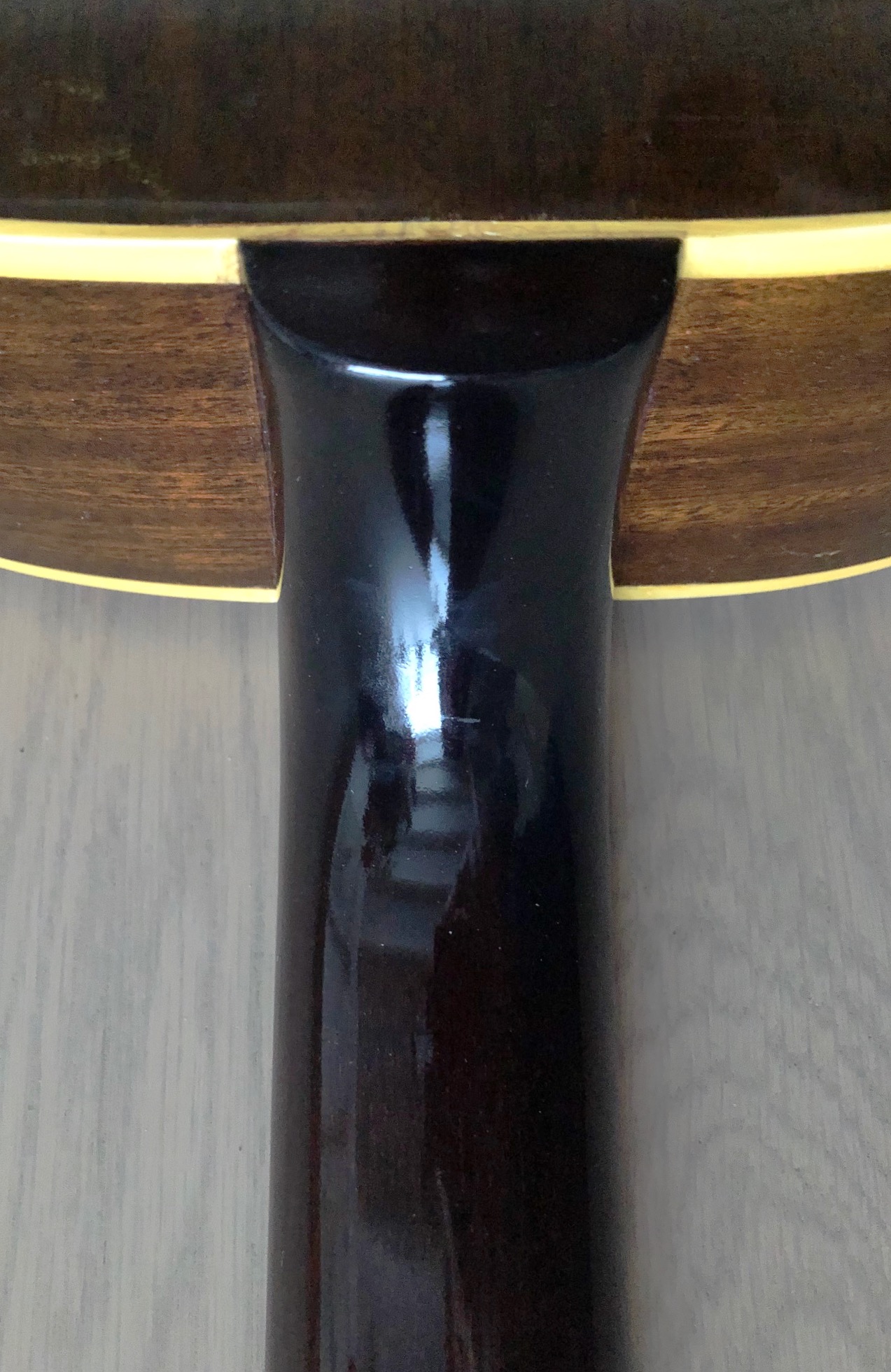

Ook deze verbinding is nog prima evenals een
mooi strak bovenblad wat bij oudere Gibsons
wel eens anders is.


Een bovenblad dat verder vrij van scheuren is.
De veel te dikke (en nogal grote) slagplaat is
verwijderd omwille van het beter kunnen vibre-
ren van het bovenblad. Heeft onmiskenbaar zijn
effect gehad! Geen volledig originele gitaar
meer dus maar zeker nog wel voor jaren 
een prima "werkpaard".

zondag 23 juni 2019

Prudencio Saez MODEL 132 - Bouwjaar 1991.


Een van de duurdere modellen uit de reeks gitaren die
Prudencio Saez al decennia lang in Valencia produceert.
Het betreft hier wel het oudere model in de reeks top-
modellen van deze bouwer. Het model 132 is nu voor-
zien van een lattice bracing, zeer waarschijnlijk vanuit 
commercieel oogpunt (de populariteit van de Greg 
Smallman gitaren) Dit model is voorzien van de tradi-
tionele waaiervormige bracing en een andere kop.
SOLD.


Ditmaal een mooi fichten bovenblad dat qua klank alleen 
maar groeit naarmate de gitaar bespeeld wordt en ouder 
wordt. Ook het binnenwerk van deze gitaar laat de hoge
bouwkwaliteit zien: Prima lijmwerk, verstevigingsribben
voor de zijkanten, Een Spaanse "tong" (De hiel van de
hals in de kast doorlopend. En netjes gevormde ribben
op zowel boven als achterblad.


Een mooie rozet, smaakvol zoals ook een ebbenhouten 
toets die natuurlijk erg slijtvast is en alleen op de duur-
dere modellen wordt meegeleverd.


En een detail shot - wel degelijk ingelegd.


Deze gitaar dateert uit 1991 maar heeft op enkele onbetekenende
gebruikerssporen nog niets geleden. Frets ook nog in prima staat.
Het model 132 heeft altijd behoord tot de top van de modellen
die door Prudencio Saez gevoerd zijn.


De kam met het gecompenseerd geplaatste kambeentje.
Deze compensatie verdient voor sommige gitaristen een
nadere uitleg. Door het indrukken van de snaar, verhoog 
je de spanning in de snaar waardoor deze eigenlijk "te" 
hoog klinkt. Om dit te "compenseren wordt het kambeentje
net wat verder weg geplaatst (naar rechts / beneden)
De directe lengtes gemeten van topkam tot 12e fret en
vanaf de 12e fret naar het kambeentje verschillen dus
t.o.v.  elkaar. De laatste afstand is plm. 2 mm meer.
De bassnaren hebben meer nodig, de melodiesnaren
minder. Dat is de reden waarom het kambeentje min 
of meer scheef wordt geplaatst. In vroeger tijden hield 
men er geen rekening mee met als gevolg dat het octaaf 
te hoog klonk. De eerste stap naar compensatie werd
gedaan door de hele kam een beetje schuin te zetten.
Men treft dit nog al eens aan op gitaren uit de eerste 
helft van de vorige eeuw!  En soms zelfs ook nog wel 
tegenwoordig. Overigens een mooi recht bovenblad. 
Geen vervormingen.


Ruim voldoende kambeenhoogte bij een prettige speelactie.


Een fraai uiterlijk mag er naast een prima geluid natuurlijk
altijd zijn. Ook hier is een ebbenhouten strip aangebracht 
in de hals voor de maximale stabiliteit.


Een sierstrip verdeelt het achterblad in twee (gespiegelde)
helften zoals bij de bouw van gitaren altijd wordt gedaan.
Voor zij- en achterkant is uiteraard gebruik gemaakt van 
massieve materialen.


Secure aansluiting hals body en ook netjes gelakt op 
deze moeilijke plaatsen.


Zoals te doen gebruikelijk zijn er geen positiemarkers
geplaatst op de zijkant van de toets. Kan kosteloos 
voor U gedaan worden.


Pittige kopvorm maar wel gevoelig voor schades bij de
plaatsing van de gitaar tegen een muur. Niet doen dus.
Breedte topkam 52 mm. Mensuur 650 mm.


Nu allemaal nog helemaal gaaf van uiterlijk!


Nette en goed werkende mechanieken die toch altijd 
weer een sieraad zijn op een goede klassieke gitaar.
Hieronder een reactie op iemand die informatie vroeg
over zijn Prudencio Saez uit 1998, toen nog exact het-
zelfde uitgevoerd als de hier aangeboden gitaar.

Re: Guitar Prudencio Saez, model 132 Message by 
Alejandro Gerardo 2015, I have one and I am delighted!
Comfortable, sonorous, many harmonics, and the finest 
neck I have ever seen. Mine is Madagascar rosewood 
and a spruce top  all solid. When they stopped making 
them,  it was listed for 1,600 Euros. It is superior to the
model 138, clearer sound, better bass, very balanced. It 
is on a level like guitars of 2000-2500 € current. It will
cost you a lot to replace it, the others will sound less 
or they will be hard, or deaf, or less harmonic ... If you
want something more, you tell me, in open or private. 
Regards Alejandro Gerardo

Black Widow Electric Guitar (Matsumoku) plm. 1972 / 1974


In fact not my guitar but the Acoustic brand (USA) introduced 
this model being quite scarce and played by Jimi Hendrix and 
Frank Zappa (among others). Quite heavy but still a semi 
acoustic guitar with its' cavities. There are very few 'parts'
pictures on the internet alas, so I will make them and explain 
what I found further around these remarkable guitars. Take a 
listen to one of the Black Widow guitar video's on YouTube.


A bit in the Gretch tradition as that brand also equipped the back
of some of their models with a leather looking piece.


What is original and what is not I'm still not able
to say but the pick ups do not seem to be humbucker 
types of pick up as the magnet are in the middle and 
within time I will take more pictures of these Maxon
type pick ups and in fact the same as on the guitars
of Jimi Hendrix and Frank Zappa. They more look 
like the so called P 90 pick ups from Gibson. But
a dummy coil on top could be responsible for the 
fact that it works as a humbucker. A fretless version 
of the first edition of these guitars was given to 
George Harrison. Quite rare but he used that guitar 
on the "White Album" in the song "Happiness is 
a warm gun". Sold in 2020 at Bonhams' for about 
300.000 USD.


About the same guitar found on the internet. No logo
but certainly produced by Matsumoku - Japan. A se-
curely crafted body but the pots, wiring and selector
switch are quite mediocre. A good working bridge 
and solidly made neck with good fretwork. On the 
right my own Matsumoko guitar is visible.


I can understand that the two screw attachment to
the body might raise questions but the neck has been
sticked into the body as far as the bridge placing.
A really stable solution regarding the tension that
is coming on the neck itself. Also satisfying as
we are dealing with a 24 fret neck!


I already made remarks around the electronics but seeing 
these tuners one might believe that this guitar has been 
fitted with very deluxe tuners from Gotoh, a respectable 
factory and brand. They work very well.


This added piece of wood to the actual neck is making this 
guitar stable and apart from that the neck that is quite long 
it still is absolutely straight and can be adjusted if needed
by a built in truss rod.


The fingerboard is a nice piece of rosewood and this guitar 
has been taken apart as it needed a good cleaning and to make
pictures about how it has been designed. As for the fretwork
this guitar needs about 7 frets to be replaced. They are too
far gone. A new topnut will complete this neck as everything
was sturdily glued together and simply broke off.


As this picture attests the guitar has been provided with 
a partly semi acoustic construction. The stop tailpiece 
however has been mounted on solid wood again. I do
not think the whole body is made out of maple on this
Matsumoku made Black Widow. I think they used the
darker colored mahogany though very fine grained
(and heavy!) while the cap glued on this wood seems 
to be maple indeed.


A bit strange is that the neck pocket and the pick up cavity
are done in one move. There is no issue in this construction
as the neck moves all the way through the cavity here above.


Besides the two holes for the neck attachment there is a 
third insert used to install a round piece of cork on this spot. 
The neck itself has the same small cavity and together with
the two screws at the end of the body and one screw near 
the bridge it makes a sturdy fit for this neck and gives the
possibility to adjust the neck / body angle. The pick ups 
have been mounted with springs so the possibility is there 
to adjust the height of the pick up pole pieces to the strings.
I also would have supplied the screw for the neck near the 
bridge with a spring to make the connection even more 
stable. Now the tension of the strings alone have to hold
the neck in its' place. That extra spring would have acted 
as such. Can also be installed afterwards.


The cavity for the selector switch is also a difference 
between the formerly produced Black Widow guitars 
in the USA. This is more in the Gibson tradition but
can be used as a confirmation this guitar to be produced
 in Japan either not branded or Aria branded though 
Moseley claimes the last 200 guitars to be made by
himself. He already had connections with the Japanese
workforce in an earlier stage.


The non branded headstock is a bit of a mix between a Gibson 
and an old Kay guitar, popular long ago in the USA. The truss
rod cover is another detail to look at. Most of the original truss
rod covers do have this shape but there are also covers 
modelled in another, more square way.


Discussions may arise around these pick ups but these are
the Maxon produced ones. The pole pieces can be adjusted
with an Allen Wrench key. And the rather wide coil seems 
to betray it not to be a humbucker pick up though the possi-
bility may arise that there are two coils placed on top of each 
other. And indeed there seemed to be a dummy coil placed 
on top of the real coil.


Another side view where the springs can be seen for
height adjustment,


To my opinion AlNiCo magnets but I'm not a connaisseur
in that field. The pick ups work very well in combination
with this guitar. That cooperation isn't always there but when
you take a look at the Danelctro Convertible guitars in
combination with their lipstick pick ups. Great sounding.
As for AI, the magnets used by Matsumoku were AlNiCo 8.


On the left there is a extra ground lip to be screwed together
with the mounting of the pick ups. Both pickups are showing
some slight detoriation of the magnet strength which results
in a weak first string signal. Experiments with a strong 
magnet made clear that it was all about the magnet strength 
as you can (temporarily) restrength the magnets with a
a good and even sound result but it vanishes after a while.
Therefore some new magnets (AlNiCo V) will be
mounted in the near future.


This is the back of an original Acoustic USA produced guitar.
4 screws to hold the neck. I think the Japanese did a very 
successful addition in adding a piece of wood all through the 
body's guitar as the neck is already quite long and therefore
must be able to resist a lot of tension. On the other hand I
presume the American made guitars are fitted with better 
quality pots and pick up selector switch.


More screws for the imitation "leather" back plate.
Moreover, the switch cover plate difference can be 
seen as well. I think to have seen a volute on the 
back of the head of an original "Acoustic" branded
guitar as has been published here beyond!


On the left is the "Acoustic" branded back of the headstock
so USA made. The original tuners on that one have gone but
they are present on the back of the head on the right but
the "original" USA made one indeed is made with a volute.


This is the original bridge with their specific rounded saddles
that can take care of the right intonation with Allen Wrench
screws. The bolts on either side cannot be adjusted in hight 
as they are resting on the bottom of the bushings in the body.
You are able to change the height of the bridge with the nuts.


The 'hole" in the middle has been ment for the third screw
to hold the neck. As the distance between the two visible 
outer screws at the end of the body and this one near the 
bridge is quite big, it makes a very reliable connection.
To my opinion the bolts are a bit too long as now they
are resting on the bottom of the bushings for the bridge.
You can always swap these bolts for shorter ones.


The rather big saddles were ment to add more sustain to the 
guitar. Though there is a cavity up to the bridge in the body,
the 2 bolts are mounted in an embedded metal part in the body
Two nuts at the bottom can be used for the height adjustment.
The bolts are not screwed so the bridge can be taken apart
easily when necessary.


The "leather look" plastic cover on the back has been
mounted with sort of push buttons and can be removed
in order to get access to the control cavity. The Japanese
models have this unit screwed, in fact more safe as by 
pulling it off, the "pillow" can be easily damaged.


In fact the form of the stiching in the middle should
look like a Black Widow spider, hmmm..


With most parts removed from the body, a good cleaning
might do a great job and it does. For that purpose I'm
using a mild component often used by violin makers:
The so called "Nicko" fluid, a French product.