Zoeken in deze blog

zondag 19 juli 2026

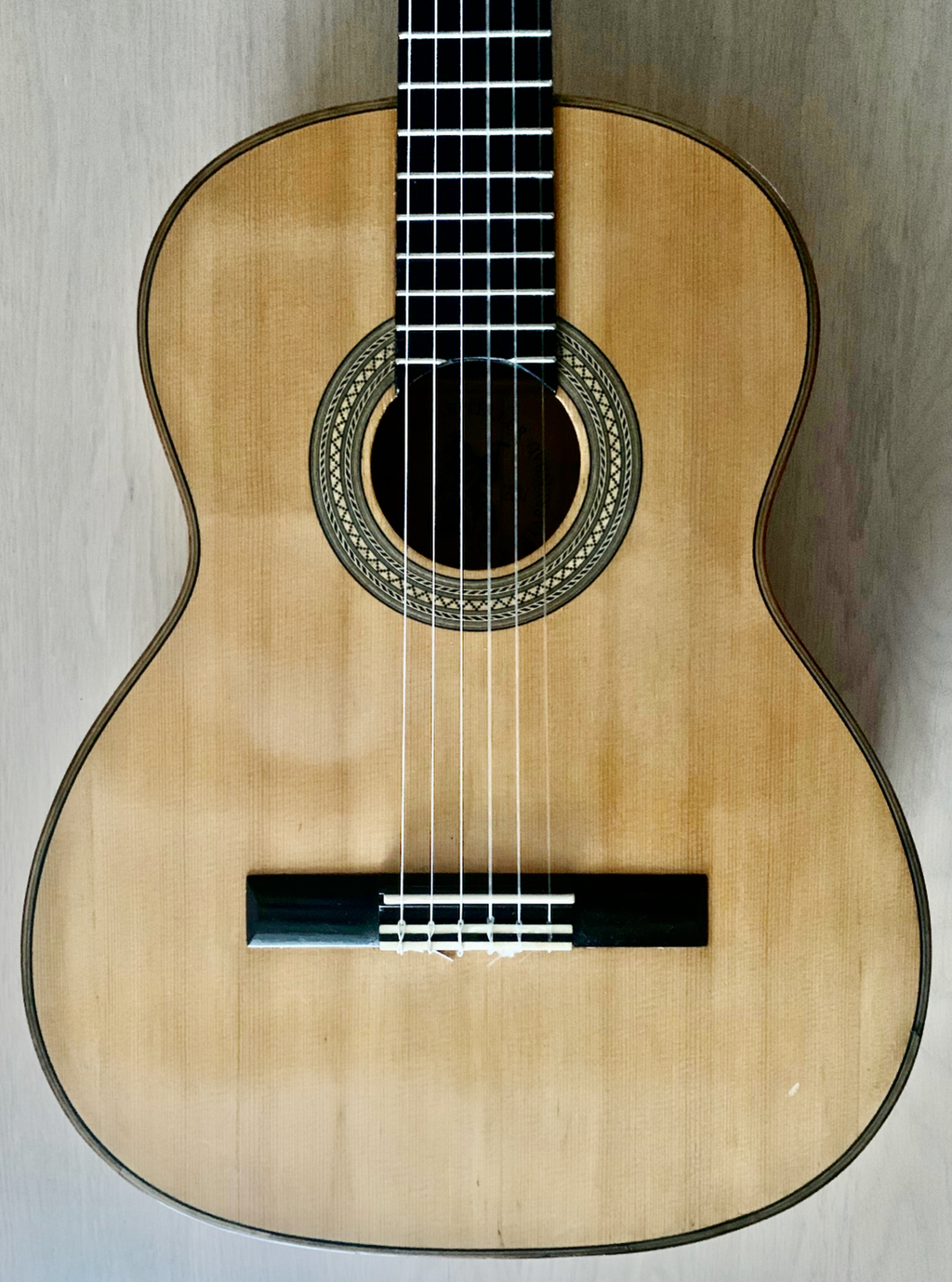
Juan Montes Rodriguez Model 146 (?) from 2024


Until recently I haven't heard of this luthier from Spain. It is not
an old brand with its' roots more than 100 years ago but we all have
learned from others along the way so let's take a closer look and
have a close listen to this guitar coming from a luthier near
Valencia.


It starts with a lot of ornamentations, in fact for me not necessary
and as for the model of the head this wouldn't be my first choice
either. But bilt qualities are really OK and a Spanish guitar with
supreme tuners are most of the time not that readily available.


Abetter racing for the topnut was one of my wishes here but that 
can be done quiet easily. Very smooth working tuners though.


You can always swap the knobs if you alike pearloid better


Strange enough the exact model has been mentioned, just "Nino"
what would grow the expectations it to be an entry level guitar.
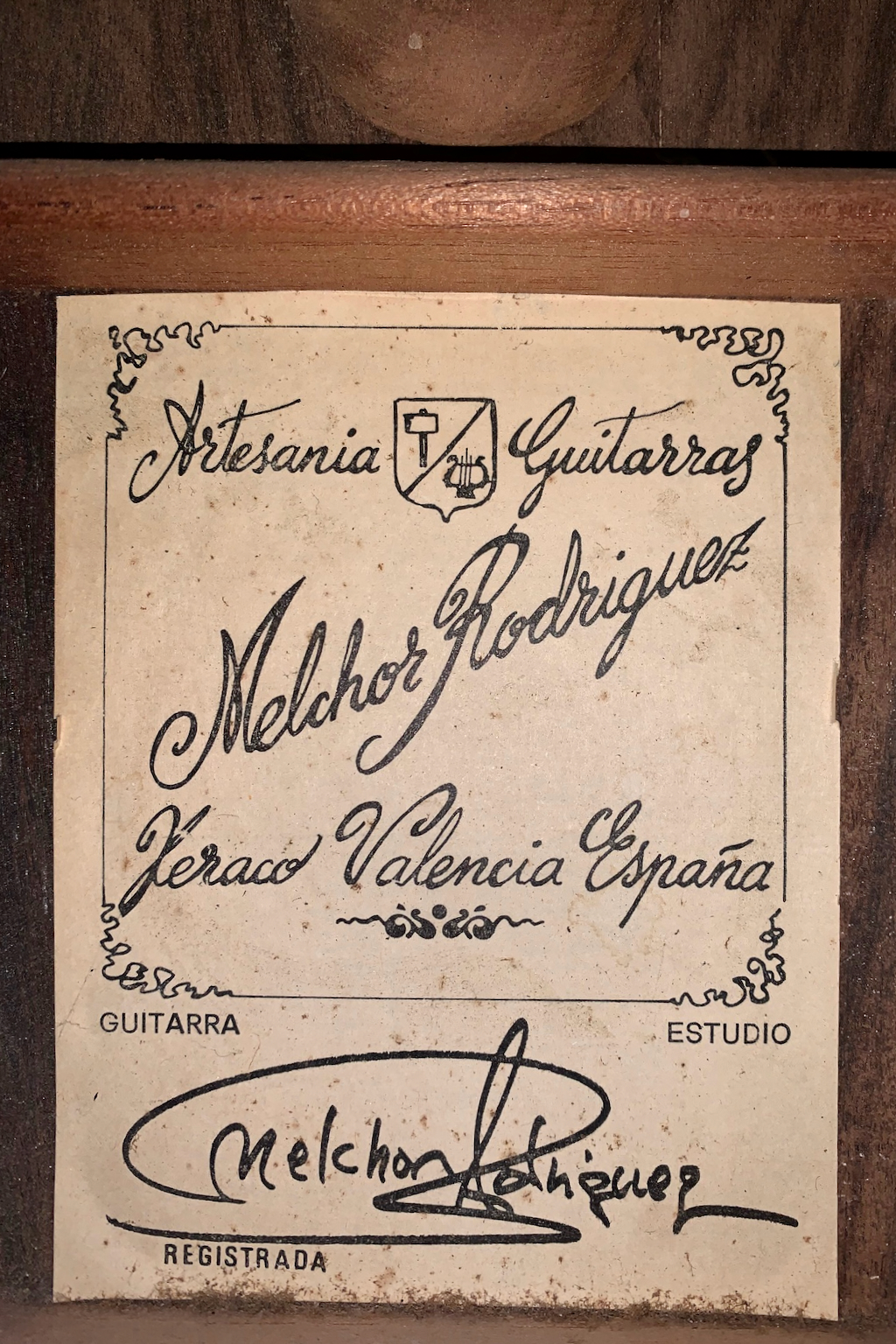
It is ment as a Flamenco model and the label has been signed 
and dated by the maker. We'll try to get in touch with them.


What I particularly like is the rather low bridge as then also the 
weight won't have a negative influence on the final sound. You can
also detect the use of a twelve hole bridge. All finally executed.
Therefore it surprised me when moving in another bridgebone 
that there was a sort of lacquer compound under the bridgebone 
that really should not be there. Possible the top has been sprayed
with the slot of the bridge uncovered? A soft compound under
the bridgebone embarrasses the higher frequencies to come out.


But a lot of attention has been given to the edge inlays and
the overall inlays on sides and back.


Hardly any play wear on these frets. And luckily no damages
on the head points as this modelling is proven to accidents.


This is of course a rather strange move om these guitars:
They are stating that they re using Indian rosewood but 
we could also have used Madagascar rosewood, a rather
valuable species. No price differences?


zondag 15 maart 2026

Asturias John Mills Model 3456 Classical Guitar (M. Matano) EN


Presented here is the Asturias John Mills model
 Nr. 3456. Similar to the MJ 15 that later has been
renamed to model "Custom". It costed about a 1000
to 1500 Dutch guilders back in 1980 The addition
'made by Masaru Matano" makes it in fact all more 
interesting. He was a very gifted luthier and I must 
say: Everything you are looking for in a classical
guitar simply is there: Lots' of volume, clear tone,
good separation, strong and beautiful bass response
and apart from that all it colors nicely once striked
at different spots on the strings. Scale: 655 mm.


As the headform already attests, this is a genuine
Antonio de Torres model made by Mr. Mantano.


A good thing to see on this guitar are the Gotoh tuners
invariably used on these high end guitars. They work
like butter and in fact are technically spoken better
than their Spanish equivalents from Fustero. SOLD


Though some slight nail damage, no fret wear so this 
guitar can serve a new owner for years to go. The top-
nut has been adjusted to a better hight.


At the end of the collaboration most likely as this label most
of the time was used with a production number stamped on it.
Masaru Matano never did that but those later 3456 models 
might be good as well regarding sound as standards were 
high at the Asturias workshops. Masaru Matano left the
Asturias workforce around 1981. In this way this guitar 
can be dated a bit.


An even more close look at the label.


The body still made with a spruce soundboard and that
is responsible for its' nice clear voice but still with the
warmth you want from a classical guitar. The sound-
board has been provided with a 7 fan bracing according
to most Antonio de Torres guitars. SOLD


For those who want to study the rosette even more closely.
The string tie block has been edged with a harder material.
In fact good to prevent any damage to the wood itself. A
slight damage near the bridge just where the first string has
been tied. A typical damage that occurs when the string 
once under the proper tension suddenly looses. I always 
advice my clients to put a knot in the string tp prevent
these kid of images for the first 3 strings. A new
bridgebone has been added as well as new strings


Knobs that can be switched if wanted. The same tuners
as on a Hirade / Takamine guitar and I also saw some
Asturias guitar with a bit of a Takamine like headstock.
It wouldn't surprise me that at a certain period this brand
was involved for a while. Rollers cleaned as well as
the fretwork on this guitar.

dinsdag 15 juli 2025

Amalio Burguet Model AB (2006) / Amalio Burguet model 1A (2005) EN


Presented here is the top model of Amalia Burguet, the
so called AB (Amalio Burguet) model. I'm not sure wether
if every AB model has been equipped with a so called 
"Doble Tapa" which means a layer of a softer wood (spruce) 
mounted before the back, the way Manuel Contreras 
reintroduced. This one is provided with this double top 
(or back). Besides that the sides have been veneered with 
a layer of Cypress from the inside. Difficult to detect 
differences between these models and a 'normal" guitar 
but the response of the higher notes is beautiful rounded 
and very even in sound and in fact comparable to a
Jose Ramirez 1A which is no surprise as Burguet also 
built guitars in the "Madrid" tradition. Lot's of volume, a
 bit darker sounding and a good playability at the same 
time. Scale is 650 mm. Playing action measured on the 
12th fret is 3 mm for the 1rst and 4,5 mm for the 6th string 
with about 3 mm of protruding bridgebone that makes it
possible to even lower the playing action. What is of 
even more importance is that the strings are making a 
steep angle over the bridgebone so no loss of tone 
when altering the height of the strings. List price at this
moment: Around  5900 Euro's for this example 
Now: case included: Price € 2500,-


A question of trust of course but I guarantee a playing action
of 3 mm for the 1rst and 4,5 mm for the 6th string here.


The head presented here has the carving "AB" in
the furthermore graceful head design.


A fine grained spruce top with a bracing of its' own.
You can't describe it as a lattice bracing but it is also
far from a traditional fan bracing. More about this
bracing and a slight problem around it further here


The rosette as well as the edges are beautiful executed
regarding inlay work.


Enough bridgebone left to even lower the strings without
sacrificing anything from the tone as the strings are making
a steep angle over the bone.


I've included this picture as you can see a varnish
crack that runs from the bridge to the sound hole
on the left. As a restorer you would like to know
wether it is a crack all through the wood or just
in the top layer of the varnish. Therefore a light
bulb works well, especially with a spruce top as 
this wood shines through. Together with a close
inspection with a mirror the conclusion can be 
drawn: No crack on the inside visible but the 
cause became clear to me:

One of the braces for the soundboard in that area
came loose in the past, thus causing a weak spot in
the soundboard there as a result from the tension
of the strings. Regluing the brace was not a big
problem and strengthening the spot in this way
has been executed. It doesn't' has any influence
on the final sound. The bridge has also been made
out of Madagaskar Rosewood as is the veneer
layer on the front of the headstock.


For me a bit of an odd looking type of rosewood though
investigations learned that Burguet uses Madagascar 
rosewood for his premium model guitars but a remark 
has to be made. The most recent AB models aren't 
equipped with Madagascar rosewood, though a model
with this species still can be ordered but at "another
price' and under another name.


This is the more recently launched Amalio Burguet 
Anniversary. Description learns us that this model 
in fact is identical to the older presented AB model
but again the Madagascar rosewood option can be
had here. Here beyond you will find the other extra's
on this model:

- Wood dried for more than 20 years has been used.
- The soundboard has been made out of solid spruce.
 - A special mother of pearl decoration on the head.
- Solid Madagascar rosewood  (but in fact laminated!)
- Sides are cypress laminated but on the older AB 
model rosewood has been used.
- The back has the so called Doble Tapa (Spruce layer)
- Bone has been used for topnut and bridgebone.
- Bridge made out of Madagascar Rosewood.
- Use of nitro -lacquer for this instrument.
- Handmade in Spain.


Great tuners as well and I think we have to be grateful
the older Spanish luthier companies stopped using the 
Fustero tuners as the company no longer exists. They 
made beautiful tuners but mechanically spoken not the 
top. These tuners are the top line of Gotoh 35AR510P.
but also can be found on the internet under "Gotoh
Hauser" tuning keys. (See below)


For more information please click on the picture. These
tuners are far superior to any others I've come across, 
including the Fustero's and other brands.


And with their knobs clinched on the axes. The "AB" 
monogramme has been carved out of the wood as
opposed to the "Anniverario"  model where they
made use of a pearl inlay. In fact carving requires
moer work....


As can be studied here: No fret wear. In fact a guitar 
like new! It comes together with a like new case.


A sturdy case and most likely from Spanish origin
as were the older guitar cases around the Ramirez
and Contreras concert level guitars.


Amalio Burguet Model 1A


Presented here is an Amalio Burguet guitar that has a 
bit of a disturbing label. The Burguet company nowadays
has two comparable models: 1A and the "Amalio" model.
This model has been discontinued as it is already almost
20 years old. What puzzled me were the rather simple 
tuners. Contact with the Burguet company learned that
they never used these tuners so probably a swap from 
one of the former owners. SOLD.


The way the more luxury details are executed on this
guitar is pointing towards a concert worthy instrument.
The inlay of the string tie block and the extra ornamen-
tation of the edges around the soundboard are proof
for that. Moreover, I think that the bridge has been 
made out of Brazilian rosewood. Scale: 647 mm.


Another striking feature is the headform. On the cheaper range
of the Burguet guitars, the headform is more simply executed.
Width of the topnut is 52 mm. Ebony fingerboard.


The way the rosette has been built up can be studied here.


As the Burguet company is stating that there is no
comparable model nowadays we have to point out
the similarities with their present models. One would
conclude it to be comparable with the 1A Cedar model.


These tuners do not belong on this guitar. I've had
contact with them and they stated they never used
these kind of tuners. Anyway, they work sufficiently.


The rather more luxury inlay on the edges of the back
and the central inlays have been finely executed. The 
cedar model 1A which is priced nowadays at € 2590,-
has the same neck inlay as the model presented here. 
The edges around the soundboard are also there and
comparable.


A closer look to the back of the soundbox should be 
convincing. But it is not clear wether if Indian rosewood
has been used for this guitar. Anyway rosewood must
have been used as inspection from the inside proves.
Use of certain lacquers tend to color a guitar a bit
yellowish over time.


On some new models the rosettes are more simple executed.
One could say: "More modern and according to these times".


For people interested in this guitar: The fretwork is still very 
good though it is possible that this instrument has been refretted
in the near past. It has a scale of 647 mm which is remarkable.


Visible here are the two dark vertical inlays in the back
of the neck with in between a layer of wood, possibly
placed in the reversed direction to strengthen the neck
and thus to prevent it from warping.


I've repaired some damages to the soundboard as the bare 
wood was visible and prone to a further collection of
dirt. Though it carries various traces of use, the sound-
board is stable now and has no cracks or whatsoever.


Some pictures of the bridge though the wood used 
has a more orangy appearance in reality.


Also the way the wood "figures" is a bit "Brasilian" like
though it is known that the Burguet company also made
use of the rather similar Madagascar rosewood.


In the right side of this guitar there is a repaired crack.
It is stable now and well done from the inside. However, 
I think the outside could be French polished in a better
way. I will take care of that.


And from another point I photographed this repaired crack.
I dare to guarantee this guitar regarding this issue. But
therefore the price has been lowered of course.