Zoeken in deze blog

dinsdag 18 maart 2025

Alastair McNeill "Hauser" model guitar nr. 204 from 1997 EN


This special "Hauser / Torres" model Alastair McNeill 
made multiple times as he was already in an early stage 
interested in what the Spanish luthiers did regarding
guitar building. Provided with the genuine Torres 
head, a timeless design in itself, this guitar has been 
provided with a fan bracing of course. Moreover
however it is well known that Hauser stayed close
to the original Torres designs. Segovia played Hauser
guitars for a long time after he proposed Hermann 
Hauser to follow the Spanish way of building guitars. 
Those guitars remain iconic, also the Hauser II ones.
Prices can be compared  e.g. with the one posted on 
the Reverb site: Another second hand Hauser copy 
(Nr. 203 ) there.


Nice attention to details like the rosette pictured here. This 
guitar has been French polished which is a sign of utmost
care on an instrument like this. Do not expect hughe
volumes coming out of this guitar but a perfect balance 
and beautiful rounded higher notes supported by a great
bass response as well. Funnily enough number 203 in
the Alastair McNeill serie is offered for sale on Reverb.

That is also a Hauser model. Same as this guitar equipped
with a 7 fan soundboard bracing but that is not different
from what Antonio de Torres did. Remarkable however
are the extra braces on the back in the lower bout that are
forming a cross and that way of constructing is pointing 
towards the Hauser method of building.


Also the inlay work is there on both back and front. The wood
used for sides and back are looking a bit like Madagascar 
rosewood to me.


Quite typical are the braces that make a cross in the 
lower bout. That made me think this guitar to be a 
Hauser copy. The brace that runs through this cross 
is scallopped in this guitar and more tiny executed 
than the other transverse bars on the back. This picture
of course is taken from a genuine replica built one,
found on the internet.


The knobs are clinched to their axes and though 
not executed in "gold" these tuners work very well.
But being apparently Lansdorfer / Reischl tuners it 
is another confirmation of the guitar being ment as
a Hauser model as that dynasty of builders almost 
exclusively used these Lansdorfer tuners.


The genuine Lansdorfer / Reischl tuners are among the worlds 
best and they were also used by Jose Romanillos, Robert Ruck 
and the Edmund Blochinger concert guitars among others. They 
can be had in all kinds of varieties, plastic or pearloid buttons 
but it all  starts at about 350 Euro a pair! 


The back has been provided with a straight grained piece 
of indian rosewood which isn't a bad thing so to say. 
Moreover, these straight figured pieces of wood are less 
prone to cracks in the future. Same thing counts for the 
sides as well.


The guitar makes a somewhat smaller impression and 
regarding dimensions that is indeed the case. Moreover
this guitar has been provided with a 640 mm scale.


The purfling around the edges can be studied here
by clicking on this picture. All those details are a
confirmation of McNeills' exquisite workmanship.


The Torres shaped head. Simplicity at its' utmost.
The topnut measures 50 mm in width. As for the 
playing action on this guitar. For the high E string
it is just below 3 mm and for the lowest E string
you can expect a playing action between 4 and 4,5
mm. Together with the slightly smaller scale this
guitar is provided with it really plays comfortable.
There still is enough bridgebone to lower the 
playing if desired. I can do that for you at no
extra costs. Moreover, after buying a guitar here
you can count on a good service in case that
would be necessary.
w

The signed label by mr. McNeill living in Wiltshire.
When you google on "Alastair McNeill REVERB"
you will find another guitar from this luthier, also a
Hauser model and only one number away from this 
example although fairly high priced.


The outer heel has been decorated with taste as well.


This picture has been added to be able to study the sides.


As can be seen: No fretwear what guarantees years
of playing pleasure as this guitar has a beautiful
voice apart from a perfect balance and good volume. 
And another plus is its' playability.


Even the rosette on the Alastair McNeill guitar is close 
to the original where in the inner and outer ring inlays 
seem to "move" in the opposite way, Take a look here 
beyond where an original 1960 Hauser is presented.


zondag 12 januari 2025

Amalio Burguet Model AB (2006) / Amalio Burguet model 1A (2005) EN


You will not meet them frequently but Andres Martin made 
a lot of stringed instruments in his life. He has therefore been
mentioned in the Jose Romanillos dictionary as someone who 
learned his craft with Julio Bustamante and Marcelo Barbero. 
He was influenced by Santos Hernandez and Domingo 
Simplicio. He taught his brother in law, Javier Rojo Solar. 

His workshops were at the Rollo 3 and at Calle Divino Pastor 
22 in Madrid. He died in 1977. Scale of this guitar is 660 mm. 
Width of the topnut is 53 mm.  Price: € 900,- case incl.


It must have been a lot of work to create a rosette like this...
And the same thing counts for the edge purflings.


                The scratch plate could point towards a flamenco model as
             does the cypres sides and back but classical Spanish music suits
              this guitar as well. Profound basses and a bit of the old school
              "wooden"  tone. A good example of this sound can be found on
                YouTube where Nikos Tsiachris plays a 1975 classical guitar
                    from his hand. The guitars' own frequency lies on a G#, 
                  about 104 Herz.


Here the signed label can be admired, stating that he already
was working at the Divina Pastor 22 location in Madrid.
To our believe the year written at the lower right on this
label mentioning the year 1960. Apart from that in the
inside of this guitar a stamp can be found on the upper
bout on the left side. Near the sound hole on the right
the guitar has been signed (by 2 persons?) and dated
1960 even being numbered 275 and no doubt within 
the handbuilt range we can confirm.


His graceful and immediately recognizable head, but also
showed here is the condition of the lower frets. Most of the
time an indication in what sort of condition the rest of the
fretwork is. He also used the typical Fustero tuners from 
that time. Fretwork has been levelled and polished.


Probably I will French polish the neck as it doesn't feel
that comfortable at the moment. Or leave it the way it is?
No, on the right it looks (and feels) much better. 


Nice inlay work all around this instrument proving that
it is far from an entry level guitar. But that has already
been confirmed by the rosette itself.


And the Fustero tuners with the typical knob form
from the early sixties. The D tuner probably had a knock 
as it is slightly bowed. I left it that way as it still works
to full satisfaction.


The Cypress back with only one small crack that already 
has been stabilized. Take a look at the lower right. Do not 
expect such imperfections to have a lot of influence 
on the sound.


And the front ands back of the head, reasonably free from 
damages. A new topnut was necessary. On later models
the small center point that sticks out, has disappeared.
That was prone to damages of course and as for me, I
would have that disappear as well but I know, not original
anymore. Moreover, Martin did this later in time so it is
confirmation for this guitar coming out of a certain period.


This picture has been added as I used the string 
savers to get an even better angle over the bridge-
bone but they were in fact not necessary. A crack
running from the left wing of the bridge has been
repaired and is stable now. No need to worry about
that as it still was closing. No tensions there!
Another example of Andres Martins' work can
be found on YouTube: a 1975 model. I must say:
its' sound wasn't that remarkable as it sounded
too modest to my ears. However, when placing
a new set of high end strings hat promised more
volume and high frequencies it gives a beautiful
balanced sound though still "old school".

dinsdag 7 januari 2025

A "Marcos Escano" labelled guitar - 1999 (Flamenco?). EN


The repaired Marcos Escano guitar from 1999. Though
an unknown luthier to this day, details are convincing
it to be a good instrument and very lightly built. What
could have been expected the guitar gives lots' of 
volume. Scale length 645 mm Width topnut: 50 mm.
And the few cracks in the soundboard have been 
treated to my satisfaction. Price 450 Euro's.


Hardly visible are the cracks here, Even after a 
close inspection. On the left just above the bridge 
you can see some traces of damage when I needed
to remove the bridge. As it was repaired by someone 
else in an earlier stage but done with the wrong glue 
the bridge came loose again. All stable now but the
amateur who did this should be ashamed....


A nicely sculpted head what betrays work of a real
woodworker. Everything is showing a high degree
of workmanship. Ebony fingerboard and newly made
topnut and bridgebone. Scale is 645 mm. Width 
topnut is 50 mm.


The back of the head with the reinforcement 
all the way up to the top of the head.


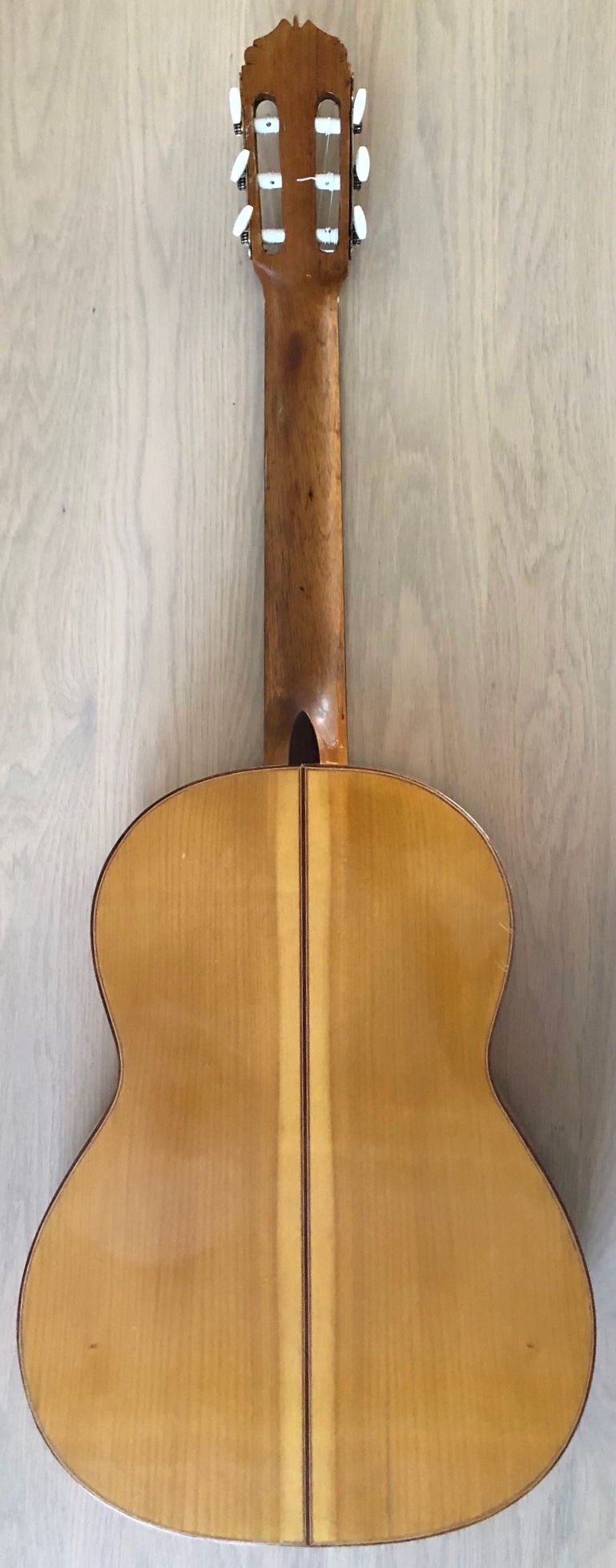
A nice cypress back with no frills but strange thing is 
that nice inlays are made on the sides, a bit unusual...


Almost undamaged after 25 years of service.


Frets have been redressed and can deliver service
for years to come.


I think the tuners to be from Alhambra as the prefix "A"
can be detected here on the left. You need to know that 
there actually is a prefix there! Clinched Axe holders
which certainly is a sign of good quality. Alhambra
delivered a lot of tuners to individual luthiers so that
explains the use of these high grade tuners on this 
guitar. Also the knobs can be switched if wanted.


And the tuners on the right side of this guitar.


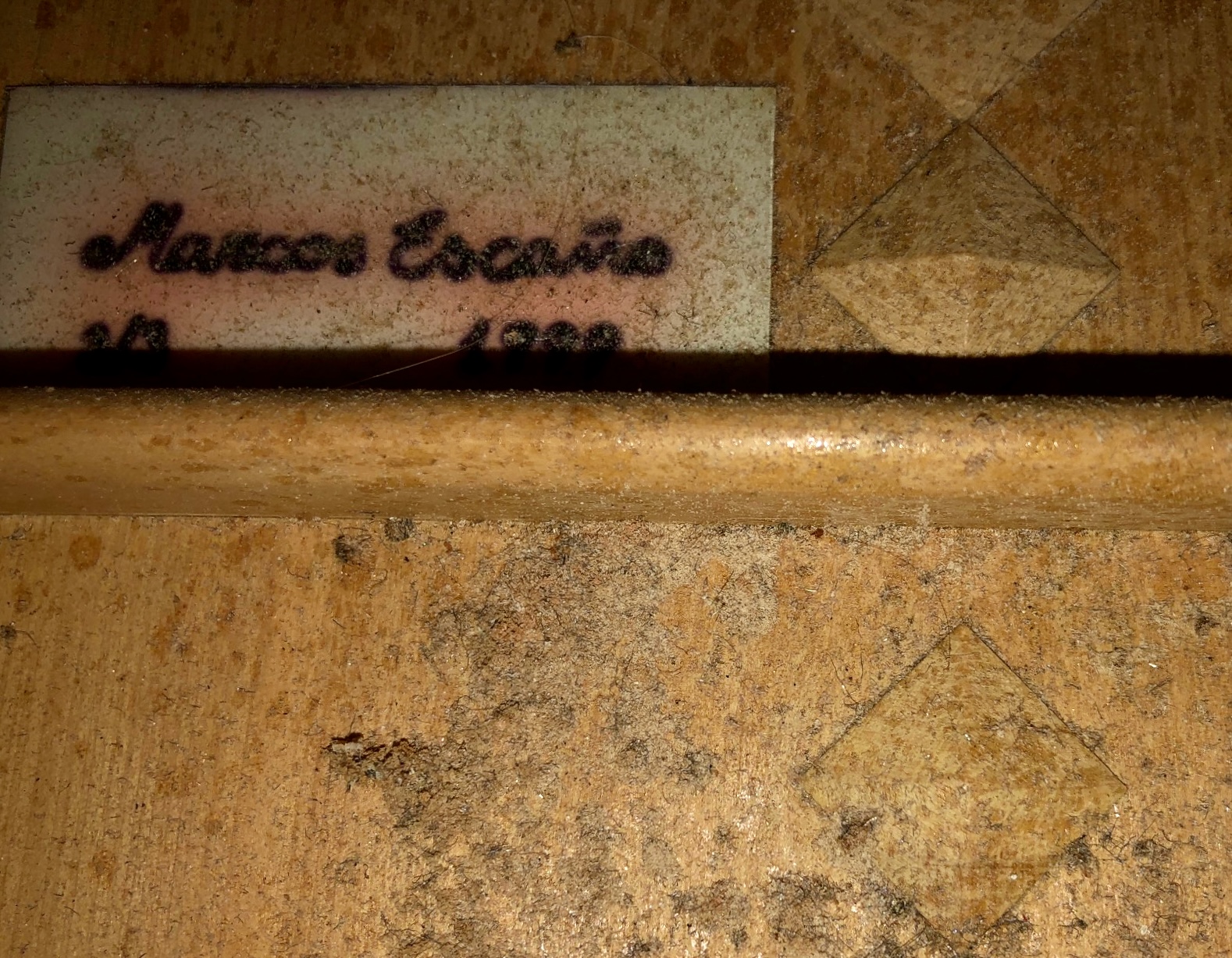
The simple label and maybe this luthier didn't built 
that many guitars. We hope to find out in the future.
Recently we heard about a Marcos Escano who is a 
a quite successful musician in Spain. Most likely 
he gave it a try: Building guitars. He seems to be 
situated in Malaga. Maybe an opportunity to visit 
him as I'm frequently in that area.


The blocks on the right from the label are a 
reinforcement of the two halves of the back. A lot
of extra work as a strip of wood would have done 
the job as well. This must have been done by someone
who is accustomed to wood working.

donderdag 26 december 2024

Asturias John Mills Model 3456 Classical Guitar (M. Matano) EN


Presented here is the Asturias John Mills model
 Nr. 3456. Similar to the MJ 15 that later has been
renamed to model "Custom". It costed about a 1000
to 1500 Dutch guilders back in 1980 The addition
'made by Masaru Matano" makes it in fact all more 
interesting. He was a very gifted luthier and I must 
say: Everything you are looking for in a classical
guitar simply is there: Lots' of volume, clear tone,
good separation, strong and beautiful bass response
and apart from that all it colors nicely once striked
at different spots on the strings. Scale: 655 mm.


As the headform already attests, this is a genuine
Antonio de Torres model made by Mr. Mantano.


A good thing to see on this guitar are the Gotoh tuners
invariably used on these high end guitars. They work
like butter and in fact are technically spoken better
than their Spanish equivalents from Fustero. SOLD


Though some slight nail damage, no fret wear so this 
guitar can serve a new owner for years to go. The top-
nut has been adjusted to a better hight.


At the end of the collaboration most likely as this label most
of the time was used with a production number stamped on it.
Masaru Matano never did that but those later 3456 models 
might be good as well regarding sound as standards were 
high at the Asturias workshops. Masaru Matano left the
Asturias workforce around 1981. In this way this guitar 
can be dated a bit.


An even more close look at the label.


The body still made with a spruce soundboard and that
is responsible for its' nice clear voice but still with the
warmth you want from a classical guitar. The sound-
board has been provided with a 7 fan bracing according
to most Antonio de Torres guitars. SOLD


For those who want to study the rosette even more closely.
The string tie block has been edged with a harder material.
In fact good to prevent any damage to the wood itself. A
slight damage near the bridge just where the first string has
been tied. A typical damage that occurs when the string 
once under the proper tension suddenly looses. I always 
advice my clients to put a knot in the string tp prevent
these kid of images for the first 3 strings. A new
bridgebone has been added as well as new strings


Knobs that can be switched if wanted. The same tuners
as on a Hirade / Takamine guitar and I also saw some
Asturias guitar with a bit of a Takamine like headstock.
It wouldn't surprise me that at a certain period this brand
was involved for a while. Rollers cleaned as well as
the fretwork on this guitar.