
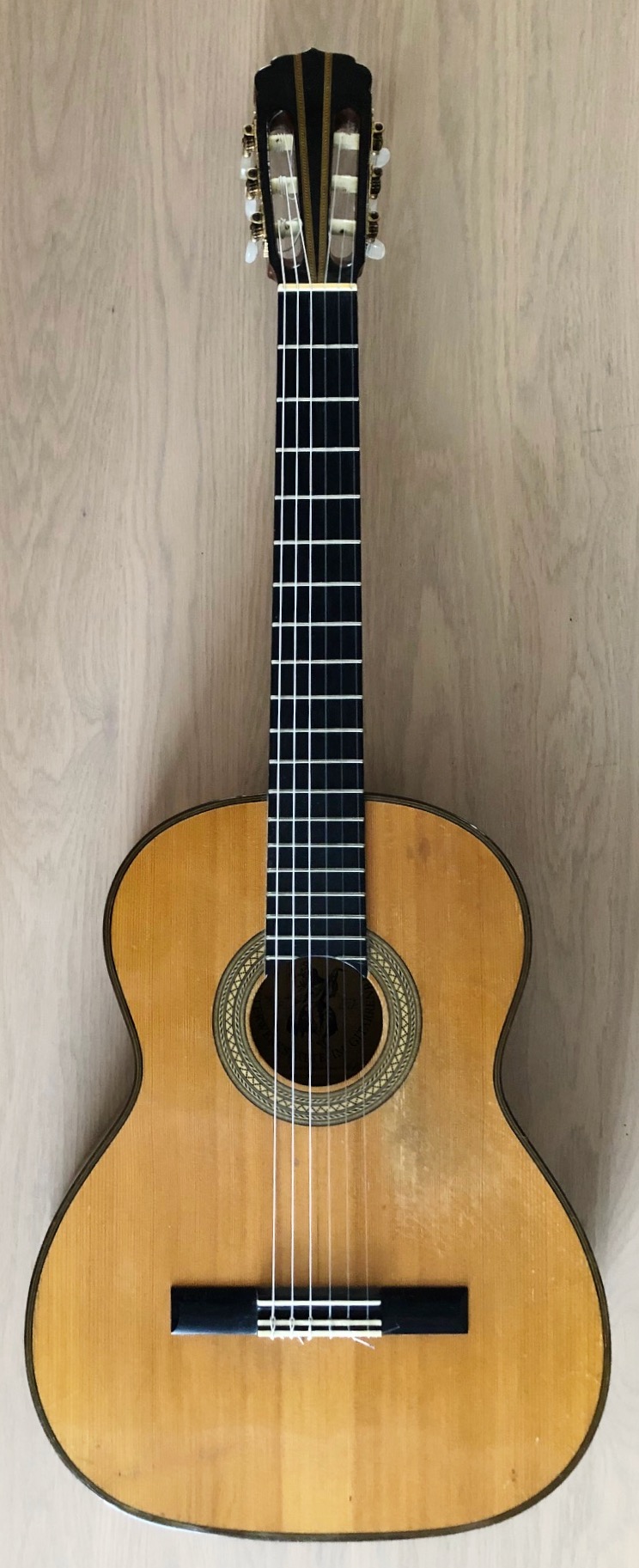
This is an Oscar Teller Classical guitar from 1971.
One of their highest models then. Fairly well played!
The P in the model number stands for Palissander
(Rosewood) while an A stands for Ahorn (maple) Most
significant detail is that Mason Williams recorded his
nr. 1 hit in the United States on a "Cordova" branded
guitar: "Classical Gas" that came from the Teller factory.
As Spanish names sold better there for that reason it
was labelled otherwise.... Price: € 1500,-

OK. The guitar needs some restorations but all in all
it can be done and a lot of things will be more cosmetic:
Some loose bindings, partly lost. It has all been solved.
Scale of this instrument is 650 mm. The own frequency
of the soundbox is G# so 104 Hz.
The label, always with the model, year of manufacture and
production number, visible on the next picture.
And a registration number as is there on this label.
The model 8 / P is still in production and lists for
2850 Euro's. Alas, not exactly the same as the old
ones. The 10 P Exclusive is the upper model now
that is on their pricelist for 4.900 Euro's. That model
is provided with Brasilian rosewood back and sides.

The back has some disturbing damage but only in the
lacquer so it will be no problem to fix that properly.
The same thing counts for the soundboard. No cracks
but a bit unrespectfully treated by its' former owner.
Most likely this guitar comes from a music institute
were they provided their teachers with a better model
guitar to give their lessons on.
Here the Rubner mounted tuners can be seen. Good quality
but a better fit is needed to have them work more smoothly.
A nicely decorated head, probably inspired by the way
the Japanese luthiers worked at that time and were success-
ful with it. A good cut topnut anyway. The front has been
veneered with an ebony layer.
The Rubner company also made cheap tuners that in fact weren't
bad at all. These are the more deluxe tuners that match the further
quality of this guitar.
An inner Spanish heel and nice inner woodwork as can be
expected from a German company existing that long. They
were in fact a violin builders family.
The rough treatment not only resulted in various needless
scratches but also a (repaired) crack in one side and an
open crack alongside the gluing surface of back and
sides. Some extra inlay work will be needed.
And what a few hours work will do!
Unfinished yet but the possibly polyurethane lacquer
has been removed here. A nice piece of wood! And
possibly be able to vibrate in a better way with a
some layers of a more modest lacquer.
By relaquering the back, head and neck some dings and
scratches can be cured and these layers are giving the
guitar a smooth feel again.
A closer look here of the refinished back
The front that hasn't been treated. I left it the way it
came to me. A guitar may have its' history
These typical inlay in the ebony head layer can be found on
two high end models from the Oscar Teller company in the
past. Mason Willams plays his number 1 hit "Classical Gas"
together with Deborah Henson Conant (Harp) on this model
guitar. Above all, a very nice musical meeting!
The tuner knobs have been riveted as was usual also
on the Spanish "Fustero" tuners of that time. I recently
got an e-mail from the Rubner company in which they
claim them not to be from their company. The Schaller
company could be the other option of course.
Oscar Teller 8/A
The first step in restoration of this Oscar Teller 8/A model was
to remove the lacquer over the whole instrument. As the lacquer
showed some craquele and had a lot of dirty and unprotected
bare wood spots that was a necessary move.
The back that already has been cleaned and is showing the
bare wood. It explains the prefix "A" in the model number:
The "A" stands for Ahorn, the German name for Maple.
Maybe a bit more uncommon but maple has some qualities
of its' own. And let us not forget: Antonio de Torres as
well as Vicente Arias, two venerable luthiers of the 19th
century also made concert guitars with maple sides and
back. To these days it still is a choice of luthiers but
the classical players, being quite conservative, are not
that eager to embrace the use of maple as it doesn't reply
to real tradition in wood use for concert guitars.
Biggest problem here was the purling and the soundboard
itself that was already loose at this spot. The purfling simply
was gone already. Luckily I found an old rosette of another
German built guitar that I've kept in storage.
And after several hours of work this is the result. It has
been composed with a lot of very thin layers and therefore
the only solution is to use some fine veneer blades and
make layers out of that. Do not glue them together but
only at the bottom where they are resting.
As the label attests this guitar is coming out of the same year
(and collection) as the model 8/P presented here above.
These two guitars are coming out of a bigger collection
most likely used for educational purposes. But the teachers
should have been more aware of the quality the guitars
provided here. They were not very prudent so to say....
A close shot where you can determine all those layers.
But the back will be brought back in a like new condition.
As the head had suffered some serious injuries there
was a need to restore the back. I used the same procedure
Wolfgang Teller uses for his present 8/P model by using
the same wood as the soundbox to kind of veneer the
back of the head. I could have used ebony but seeing
the picture here below I'm glad I didn't. I used maple.
On a rosewood guitar Mr. Teller uses rosewood for
the back of the head as can be seen here.
Now there is so much harmony when observing
this guitar from the back though still unfinished on
the left but lacquered on the right. The beautiful
figured maple is there to its' full potentials.


Geen opmerkingen:
Een reactie posten