Presented here is a high end Taurus guitar. This is more for
information as this guitar is not part of my collection. It was
offered to me for reparation. The Taurus company was situated
in Barcelona and indeed had a workforce. And some workers
learned their craft at the Juan Estruch company also established
in Barcelona and one of the oldest guitar companies of Spain.
Among the workers in the Taurus workshop we can mention
the later Antigua Casa Gol, Manuel Condal, Jose Farre
Rodriguez and Jose Grau among others. Also Antonio Picado
was one of them. He now has a workforce of 20 workers just
outside Barcelona and is responsible for the second line of
guitars for Otto Vowinkel (situated in Amsterdam)
A post at guitarsite suggests that Antonio Picado Berga, a
guitar maker in Barcelona, worked in the Taurus workshop
from 1968 to 1982 and that many Ramirez student guitars
were made by the Taurus workshop during that time.

This guitars has been built a bit in the Ramirez tradition and
though this is a high end model, Taurus also built intermediate
and possibly even beginner guitars. Refinement and use of
premium materials can prove to which class a guitar belongs.

As with several older Spanish classical guitars, this guitar also
suffered from a too high action and lowering the saddle was not
an option as the angle over the bridgebone was already hardly
there. However, I was lucky as the bridge itself was executed
quite high so lowering especially the first part of the bridge (not
the string tie block) together with a twelve hole bridge did the
job. When you are making repairs on older guitars like this, a
check up on the first frets often shows too much wear. Changing
the first 3 frets did the job and it wasn't necessary to do a whole
fret job or level all the frets. The inlay of the string tie block
is also pointing towards Manuel Condal as well as the rosette.

Simply a nice shot of this part of the guitar but in fact to show
you the influences Juan Estruch had on the way of guitar building
in Barcelona and surroundings: The multi coloured edge inlay.
Manuel Condal still followed the old master Juan Estruch.

Sometimes almost giving an idea of high quality mahogany,
this guitar has been equipped with an endangered species:
Madagascar rosewood. I could securely compare this with
a high and Amalio Burguet guitar that is claimed to be
executed out of the same material back and sides. It is
now a quite pricey wood though not yet under the CITES
protection. Beautifully straight what makes it even more
stable in the near future.

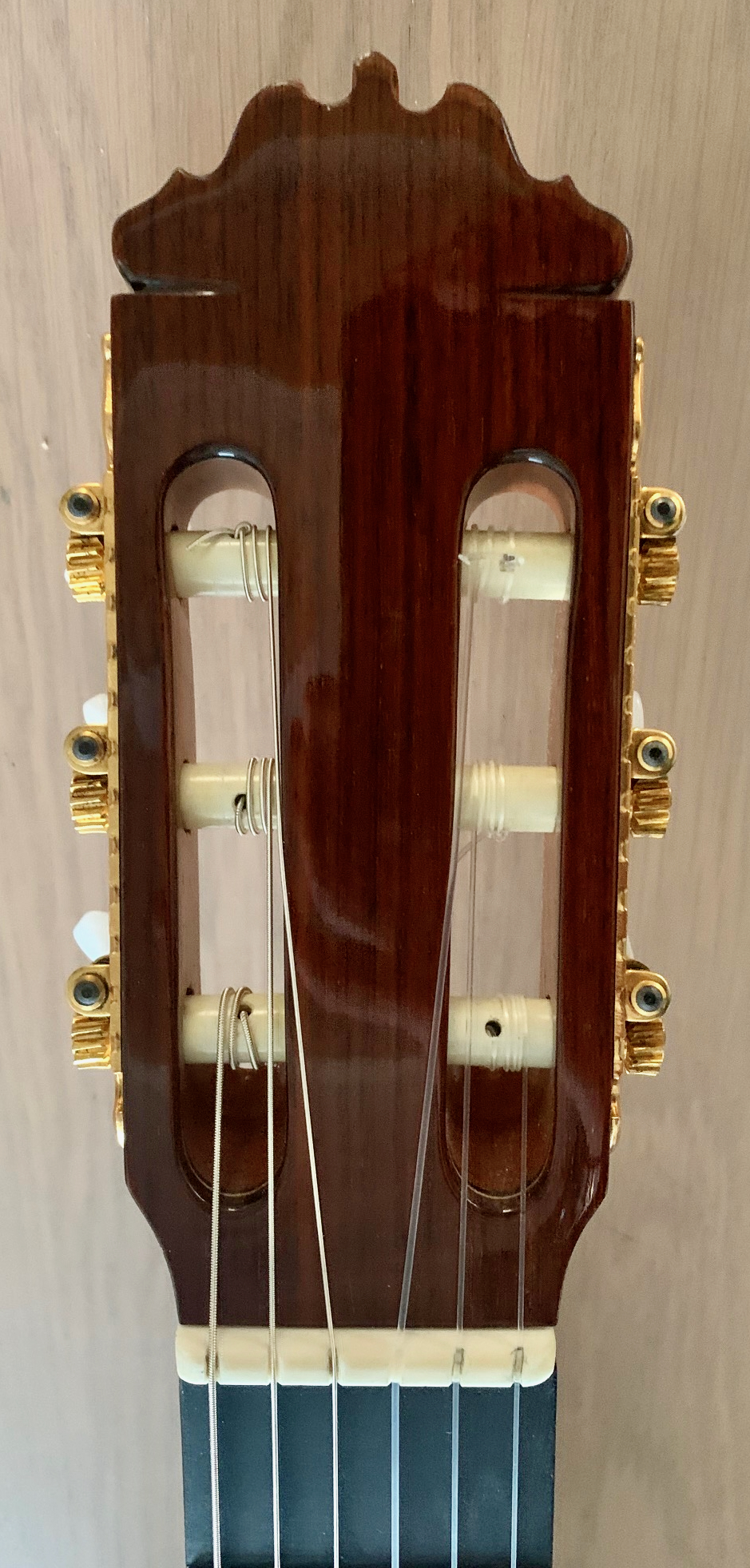
A lot of luthiers that worked in Barcelona often are
making a choice for the Ignacio Fleta head. This is
the case as well here and by the way the head is
veneered (among other details) we might conclude
this guitar to be built by Manuel Condal.

The newly installed frets matching the older fourth fret.

Possibly Fustero tuners which is another mark of a higher
class guitar. Fustero as a company is out of business, They
were widely used, beautiful engraved but mechanically
spoken not the top.

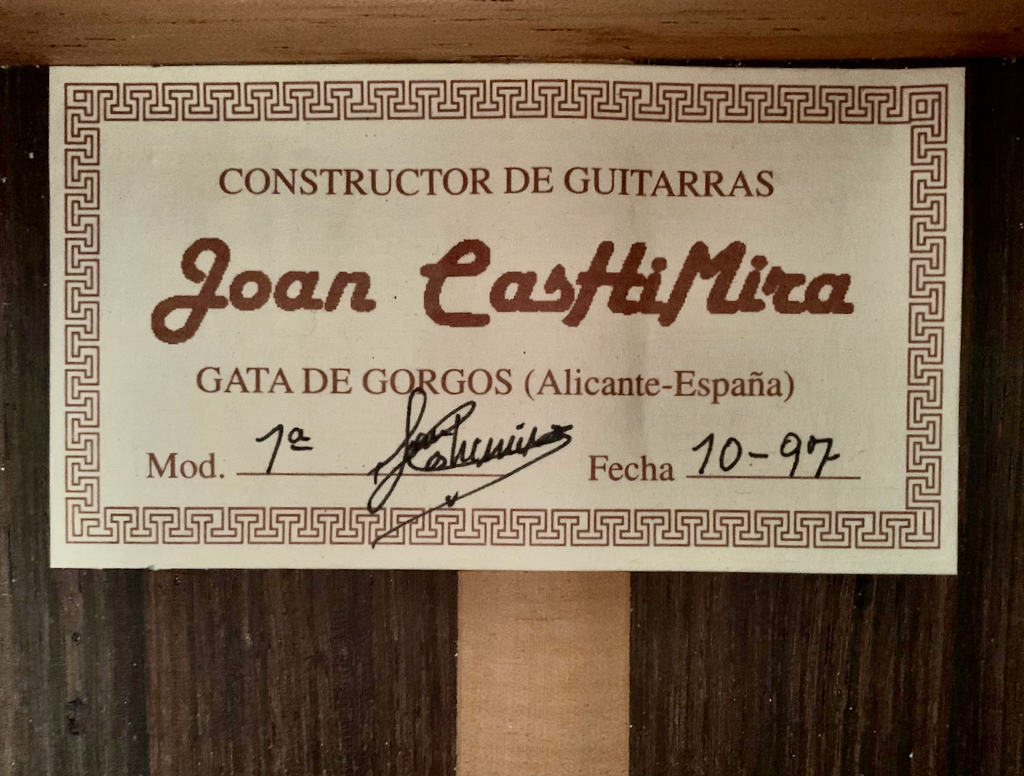
I've added the "Antigua Casa Gol " label together with
the engraved golden Taurus marking on the transverse
bar on the back of this guitar.

After a rather long search we finally discovered the doors
of the Antonio Picado workshop which we visited in Berga,
a place near Barcelona. The front didn't look that inviting
but we were welcome and they took the time for us and
our questions.

The workplace looks very neat and ready for all kinds
of guitar models the "Antonio Picado" Workforce is still
providing "Picado" guitars though Antonio Picado himself
has already retired. From the 6 workers that are active
there, 4 of them have worked in the "Taurus" workforce
and though they've kept the name, Antonio Picado, their
more recent name is "Genis & Prat Luthiers, s.l.
J. Angel Genis and Carlos Prat. You're even able
to order a guitar directly from them.

The oldest one of them already started working at the Estruch
plant when he was only 14 years old. With others they went
on to start the Taurus working force. The more recent Picado
products can be bought in The Netherlands in Zwolle at the
music shop "La Roseta".
In Spain the well known shop "Guitarras de Luthier" sells
their different models. The workers themselves were quite
enthousiastic about their "Doble Tapa"model 60, priced at
1750 Euro's. You can see their several models on the site
from this company: www.guitarrasdeluthier.com Search
for Picado. Alas, they had no stock "ready to play" guitar.
Casa Sors labelled guitar


This guitar from the venerable "Casa Sors" in Barcelona
immediately drew my attention as they are involved in
the classical guitar, have an interesting site, are organizing
concerts and workshops, have a museum and are giving
guitar lessons. I didn't knew until quite recently that they
sold guitars with their own label. As they do not built
guitars themselves, they have to import them from abroad
and that remained a mystery until quite recently.

The figure on the left of this label explains their
choosen name: "Sors" as that is Fernando Sor of
course. Two adresses have been mentioned here.

I knew I had a guitar in the past that was equipped with
about the same tongue as you can see here, but in which one?

As for materials this guitar belongs in the upper range as all
woods are solid: A cedar top combined with rosewood back
and sides. An ebony fingerboard can be described as a sign
of some superiority as is the sound of course! Lots' of volume
and a good balance between the lower and higher strings
but a typical "cedar like" tone. Scale: 660 mm. I think this
guitar to be the Raimundo model 140 as strangely enough
the sides from this particular model are made out of solid
wood while the back is laminated. (See Reverb)

I think these tuners to be the factory produced Fustero's.
The more elaborate and hand engraved tuners to be found
on the concert guitars of several luthiers are more superior.
A first sign often are the axe holders bowed out of the plate.

The headform is betraying a bit the origin of this guitar,
although Amalio Burguet produced some "Basic"named
models back in 2010 with the same headstock.

As the guitar seems to be quite a bit older to me than
only 16 years old, I exchanged my research and with a
little bit help from AI, I was set into the direction of
the Manuel Raimundo company situated in Valencia.
That made me think this guitar to have been built in the
eighties of the past age somewhere. But there have to
be more "red flags" to my opinion and comparing the
way the inner woodwork has been done, that made
my conclusion even more reliable.

The slanted transverse brace just under the sound hole is present
in the Casa Sors guitar as well. Raimundo has a lot of pictures,
also from models out of former times which makes it more easy
for owners to do their investigations. They are using different
bracings as you might notice in the pictures here beyond.

Here the inner heel (or tongue) can be seen as well as
the kerfed lining ment for gluing the sides to the back.

Again the glue lining in this picture but also the way they are
glueing the ebony strip in the neck and its' depth. Apart from
that their typical way of gluing extra (but smaller) transverse
bars, visible in the low part of this picture.

Left and right from the sound hole two rather wide
braces but now just executed as a strip here. What is
remarkable further is the strip glued under the lowest
transverse bar to prevent the neck to come forward
under the tension of the strings. That process often
starts with two cracks alongside the fingerboard
and the soundboard.

And even the form of an endblock might tell us something
about a luthier. Antonio Marin Montero used three pieces
of wood for the endblock glued in a 90 degrees grain
direction back in the sixties of the past age.

Though this model isn't their highest model strangely enough
it is superior to some higher numbered models of this maker.
I've included this label as the quality seems to be comparable
to the Casa Sors labelled guitar.

Though Manuel Raimundo (Valencia) was an already longer
existing company it remains strange that they equipped their
guitars with a bit of a clumsy label like this.
People often rely on a model number from guitar companies
but beware as often companies changed the materials and way
of building in order to speed up production sometimes or
reduce costs. It is rather difficult to determine wether if you
really have the same guitar although the model number
is exactly the same.
Another method is to stick to the same procedure when a
guitar is succesful but presented as a new, superior model
with a higher price tag of course.