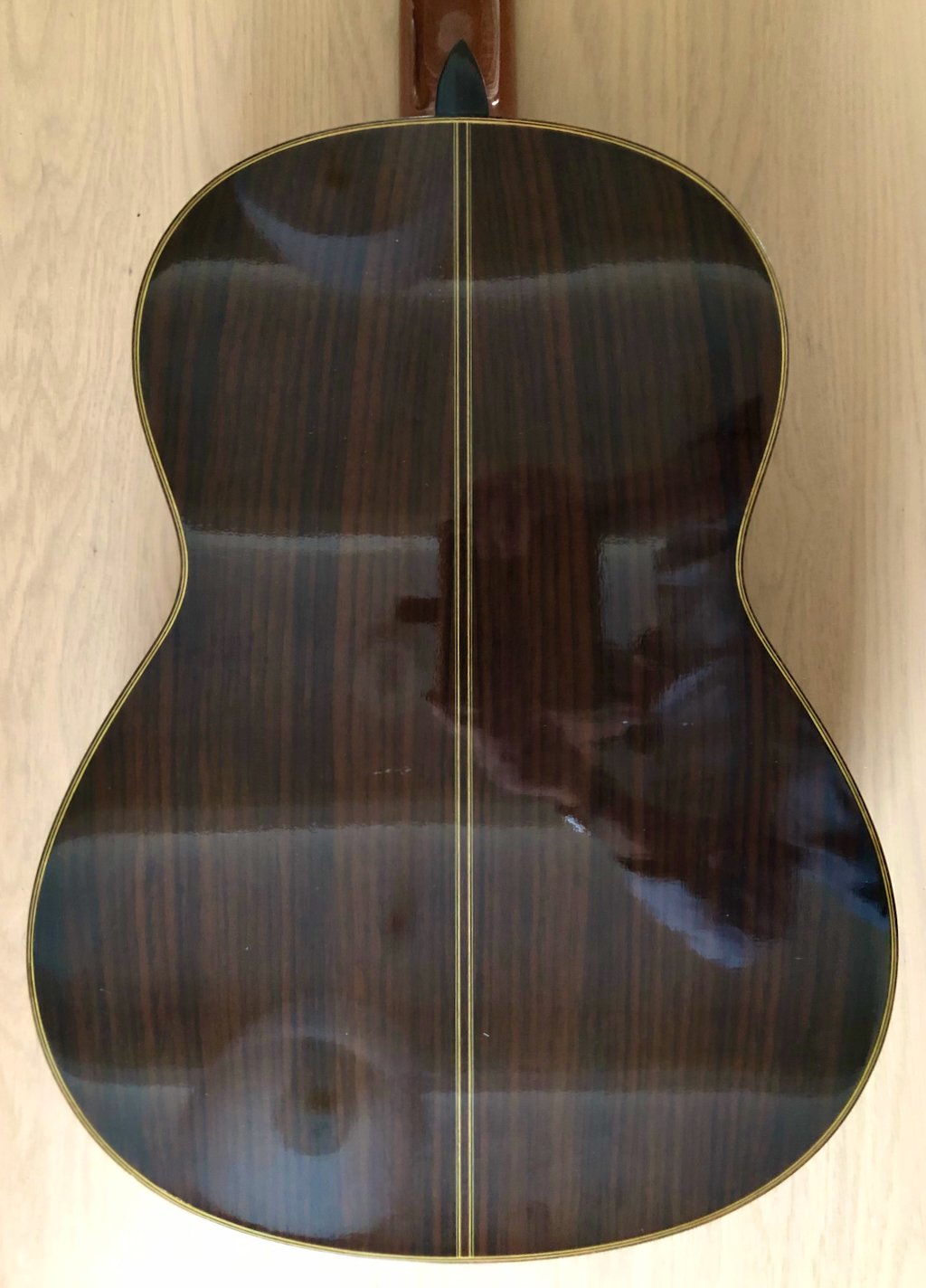
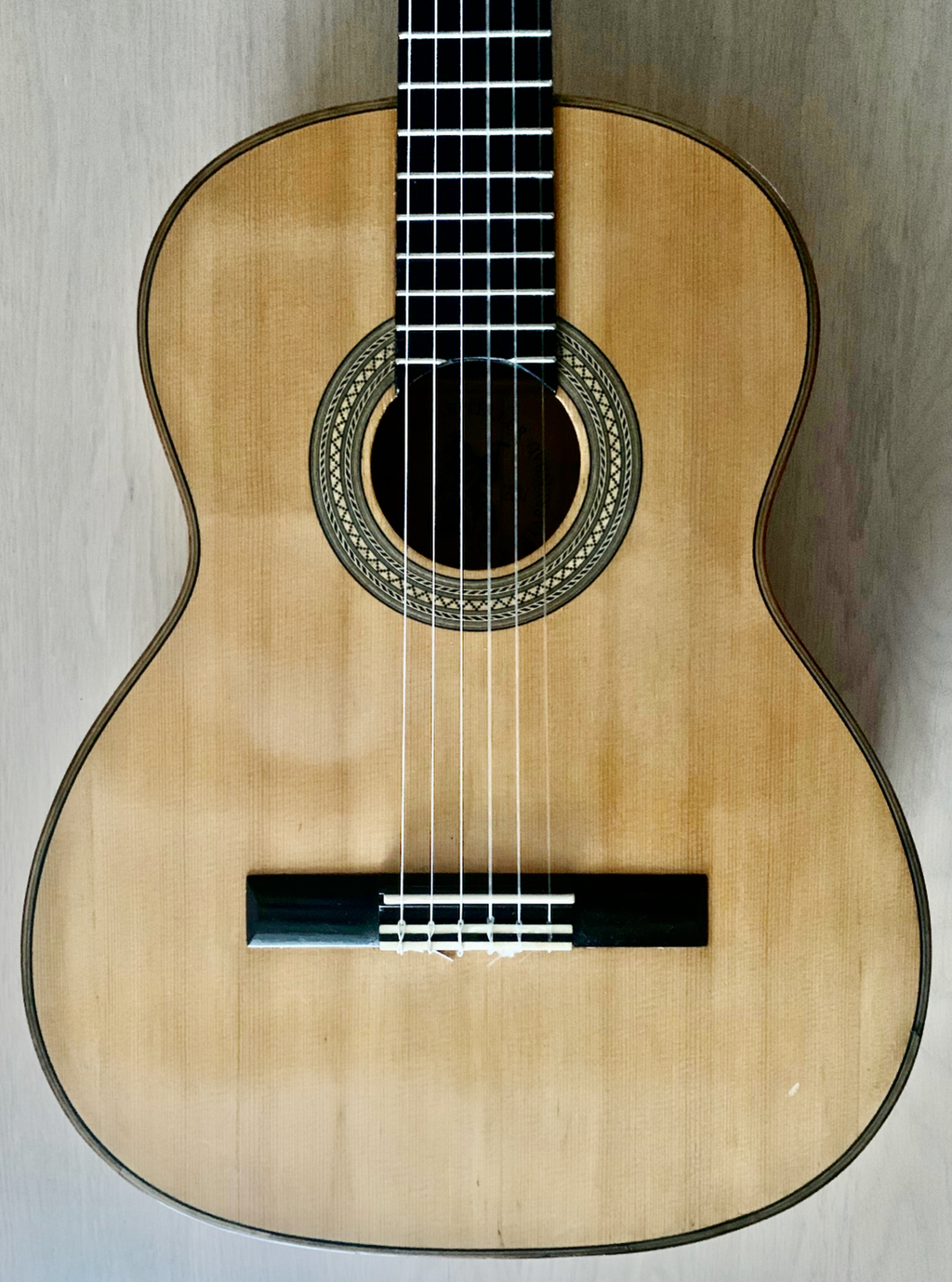
Presented here is a completely relaquered Oscar Teller 8/A
The prefix "A" stands for ahorn, probably better known as
maple. As maple was readily available in those days this
model, executed in maple sides and back, was cheaper than
its' counterpart, the model 8/P in rosewood. Nowadays it
would have been different as the lighter hardwoods are
quite popular at this moment. But let's not forget also
Antonio de Torres already used maple for his premium
models in the 19th century and so did several French
guitar builders.
A closer look at the back is possible just by clicking on these pictures.
The scale is 645 mm and the bodies' own frequency is around the note
G# which means 104 Herz. Width of the topnut 52 mm. The intonation
is really good. Due to some top cracks the price would be quiet good.
The 8/P made by Wolfgang Teller (still in business) now costs € 3000,-
As for the cracks: Everything is repaired and stable now.
The top has been French polished but keep in mind that not
all damages can be treated as then you are obliged to sand down
the soundboard. The top will be thinned then and is more prone
to deformations and might even possibly collapse.
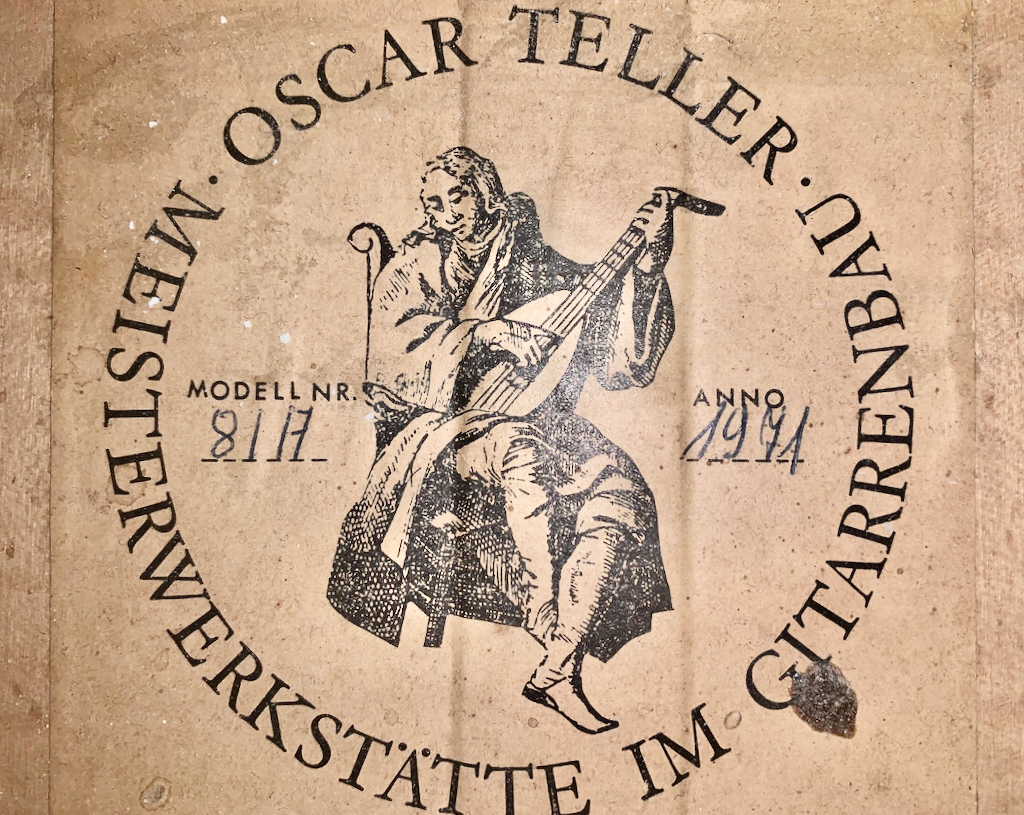
And its' label that says Model Nr. 8 / A Anno 1971.
Oscar Teller wasn't alive at that time anymore but
his son Horst kept using his fathers' name though in
fact it was Oskar, written with the prefix "K".

Hardly any fretwear. Someone must have did a job not that long ago.
The tuners were lost but these ones do the job really well.
The head often is a victim of damages from setting the guitar
against a stone wall or knocking it against that wall. As the
back of the head was severely damaged I figured it would be
nice to add a maple back plate the way later often has been
done by this company and its' builders. Moreover, maple is
much harder than the most of the time used cedar wood for
the necks.
The rosettes from those times on their premium guitars
were immediately recognizable. As for sound: the Teller
guitars tend to sound a bit dark and with this maple for
sides and back the sound is clearer and perfect to my
opinion. Anyway, I like it even better compared to the
rosewood version I have. On the right you can observe
the older rosette on a 1963 model 7/P.
Oskar Teller 7/P 1963
No, not a mistake in the announcement of this guitar.
Before the more common labels, the name Oskar was
spelled with the prefix "K". Moreover, the later guitars
most of the time were offered without the addition
"Tellson" as that name merely was used for the steel-
strings and jazz (f-holed) models. Horst was at
that time already director of the company, due to
the untimely death of his father.
And here the rather "unique" Tellson - Oskar Teller
label. That states the guitar to be built in 1963. As I
already "stumbled" onto two model 8 Oscar Teller
guitars in the past, I figured I would give it a try. And
also regarding this model, some details have been
simplified during the timeline: Same model - less
elaborate details on these guitars. The back inlay
in the neck later was a single one as opposed to this
1963 model. In comparison to the 8 models, the tuners
are also Rubners but executed in metal and not "gold"
From old pricelists and catalogues one should read
8/P and not 81P as sometimes is suggested.
As the crack running from the right side of the bridge near
the center seam was a bit open. I figured it to be better to
glue in an insert as clamping with force in order to close a
crack isn't the way to go as the stress on the soundboard
remains. A lot of people might think it will cause a new
opening at the same spot but remember: A well glued
crack isn't likely to open as the bond with glue is stronger
than the cohesion of the wood cells itself. A new crack
would develop itself on another spot which is not
very desirable. Scale: 645 mm.
Here the new situation has been exposed. A small crack in
the back has been glued to satisfaction as after an inspection
of the inner back bracing the lowest transverse bar there
will hold the back in that area in a good condition.
Still about the same nice woods Teller was using at that
time for his premium built guitars but not a fancy edge
inlay on the back or an added center strip dividing the
two halves. It doesn't has any effect on the final tone
obviously. These guitars were ranked under the hand
built concert guitars and nowadays this model has been
discontinue but it can be compared with the 77 model.
That guitar is about 2350 Euro's in price nowadays.
Later in time Teller concluded the double maple strip not
to be necessary to reinforce the neck anymore although
besides being a nice addition, these two strips go all the
way through the neck and most likely the center strip is
glued with its' grain in the opposite direction to prevent
any sort of warping and indeed, the neck is still
perfectly straight.
This guitar was available in an auction house that is not
specialized in musical instruments. Therefore a bargain
can be had here and there. Remarkable remains that
damages such as a crack on the right below the bridge
hasn't been mentioned in the catalogue. Being an auction
online a lot of potential buyers maybe are not taking the
effort to visit the auction house in person but it is ob-
vious that it remains very important to do so.
Same as on the 8 models is the rich rosette and
the ebony bridge with the two plastic strips on
the edges of the string tie block though also the
inlay of the rosette has been changed, maybe
to speed up building processes? As with a lot
of these older guitars, the necks are moving a
bit forward thus giving an unwanted high
playing action. This guitar still has enough
bridge bone to even lower the action.
On the front the two inlays recognizable on the 8 model
is not present here. The double maple strip inlay in the
neck disappeared later on the 7 models. As you can see
the axe holders are riveted onto the plate and the knobs
themselves are also clinched on the axes. They are
Rubner quality tuners.
The rosewood used for the back and sides are showing
a lot of similarities with the 8/P model. Wolfgang Teller,
the head of the firm in present times claims that Brazilian
rosewood only has been used in the past on the nr. 9
model. So not on the 8/P and lower models.


 \
\






.jpeg)