Zoeken in deze blog

zondag 19 juli 2026

Manuel Contreras (1983) Concert gitaar


1983 MANUEL CONTRERAS CONCERT CLASSIC GUITAR.
Hoewel niet gesigneerd is deze gitaar uit de beste materialen 
vervaardigd waarbij natuurlijk direct de Braziliaans palissander
zij- en achterkant opvalt. Ceder bovenblad en ondanks
de 660 mm opvallend gemakkelijk te bespelen. Prijs: 2500,-

De typische rozet uit de tachtiger jaren en uiteraard wel
wat gebruikerssporen. Hij is van een flamenco gitarist 
geweest en als je goed kijkt zie je nog sporen van een 
slagplaat die er toch maar afgehaald is omdat dat de
trillingen in het bovenblad nu bepaald niet bevordert.


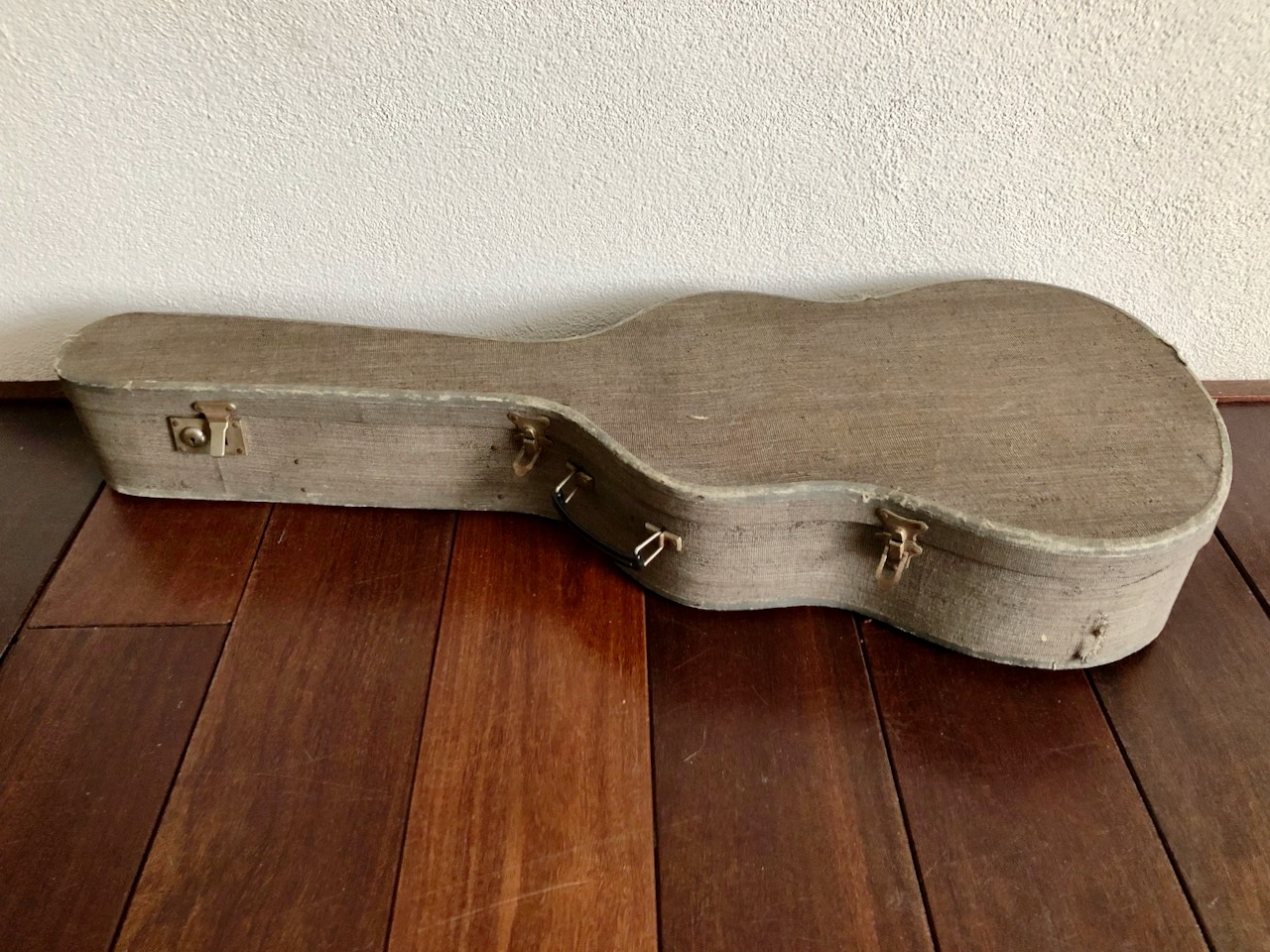
                                        De originele koffer die er natuurlijk bij geleverd wordt.


De Jose Ramirez gitaren werden destijds in dezelfde koffers geleverd.


Fretwerk in prima staat, gevlakt en gepolijst voor zover dat nodig was.


De beroemde Fustero mechanieken die eigenlijk gewoon 
op een gitaar uit deze prijsklasse horen


Let op: Alleen deze kop behoort op een concert gitaar. De 
"Guitarreria" gelabelde gitaren hebben een andere kopvorm
en worden doorgaans van andere bouwers en/of fabrieken
betrokken. Overigens doen er nogal wat verhalen de ronde
dat Manuel Contreras Sr. zelf al niet veel meer bouwde en
dat werk overliet aan overigens prima getrainde bouwers.


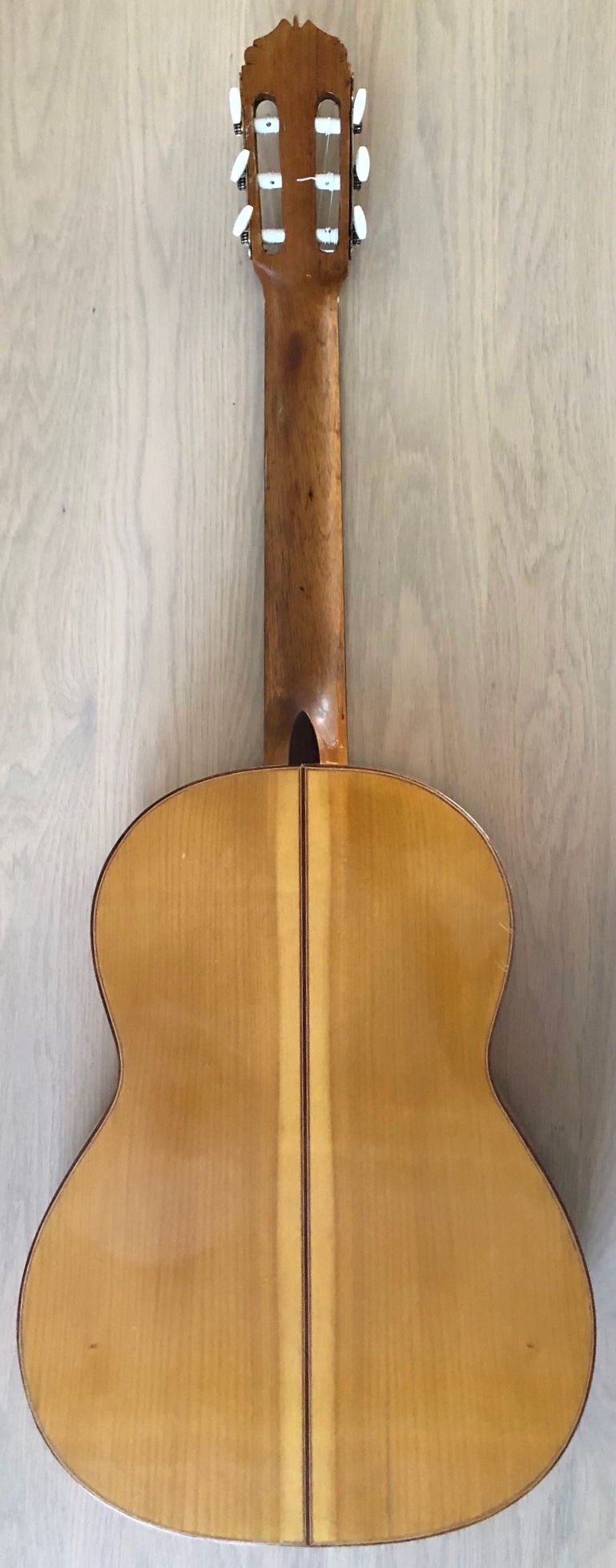
Ook de achterkant ziet er nog ongeschonden uit.


Niet gesigneerd en wellicht heeft dit te maken met de 
toets die weliswaar uit ebben gemaakt is maar wat vlek-
kerig is. Deze labels maken in feite al een onderscheid 
in kwaliteitsklasse. De studiegitaren hebben een zoge-
naamd "Guitarreria" label en de concertgitaren hebben
een "Luthier" label.


Mooi zijaanzicht om de schoonheid van dit Braziliaans
palissander te laten zien. Zij en achterkant in zeer goede staat!


Wel wat playwear van de vorige eigenaar: een Flamenco 
gitarist. Hij voorkwam meer schade door er een dikke 
plastic slagplaat op te plakken maar die is er af gehaald 
omdat dat eigenlijk de toon van een gitaar om zeep helpt, 
zeker als de slagplaat te dik van uitvoering is zoals dat
hier het geval was!


Mooi recht bovenblad en dat na al die jaren. Daarnaast is
de speelactie zeer prettig met voldoende kambeenhoogte.


In prima conditie, dit achterblad!


Wellicht voor een toekomstig eigenaar om het bovenblad
toch maar een keer te laten refinishen. Ik zou dan zeker
opteren voor het aanbrengen van French polish in de 
volksmond politoeren genoemd.

zondag 15 maart 2026

Andres Martin de Diego - Concert guitar 1960 (Signed / Dated). EN


You will not meet them frequently but Andres Martin made 
a lot of stringed instruments in his life. He has therefore been
mentioned in the Jose Romanillos dictionary as someone who 
learned his craft with Julio Bustamante and Marcelo Barbero. 
He was influenced by Santos Hernandez and Domingo 
Simplicio. He taught his brother in law, Javier Rojo Solar. 

His workshops were at the Rollo 3 and at Calle Divino Pastor 
22 in Madrid. He died in 1977. Scale of this guitar is 660 mm. 
Width of the topnut is 53 mm.  Price: € 900,- case incl.


It must have been a lot of work to create a rosette like this...
And the same thing counts for the edge purflings.


                The scratch plate could point towards a flamenco model as
             does the cypres sides and back but classical Spanish music suits
              this guitar as well. Profound basses and a bit of the old school
              "wooden"  tone. A good example of this sound can be found on
                YouTube where Nikos Tsiachris plays a 1975 classical guitar
                    from his hand. The guitars' own frequency lies on a G#, 
                  about 104 Herz.


Here the signed label can be admired, stating that he already
was working at the Divina Pastor 22 location in Madrid.
To our believe the year written at the lower right on this
label mentioning the year 1960. Apart from that in the
inside of this guitar a stamp can be found on the upper
bout on the left side. Near the sound hole on the right
the guitar has been signed (by 2 persons?) and dated
1960 even being numbered 275 and no doubt within 
the handbuilt range we can confirm.


His graceful and immediately recognizable head, but also
showed here is the condition of the lower frets. Most of the
time an indication in what sort of condition the rest of the
fretwork is. He also used the typical Fustero tuners from 
that time. Fretwork has been levelled and polished.


Probably I will French polish the neck as it doesn't feel
that comfortable at the moment. Or leave it the way it is?
No, on the right it looks (and feels) much better. 


Nice inlay work all around this instrument proving that
it is far from an entry level guitar. But that has already
been confirmed by the rosette itself.


And the Fustero tuners with the typical knob form
from the early sixties. The D tuner probably had a knock 
as it is slightly bowed. I left it that way as it still works
to full satisfaction.


The Cypress back with only one small crack that already 
has been stabilized. Take a look at the lower right. Do not 
expect such imperfections to have a lot of influence 
on the sound.


And the front ands back of the head, reasonably free from 
damages. A new topnut was necessary. On later models
the small center point that sticks out, has disappeared.
That was prone to damages of course and as for me, I
would have that disappear as well but I know, not original
anymore. Moreover, Martin did this later in time so it is
confirmation for this guitar coming out of a certain period.


This picture has been added as I used the string 
savers to get an even better angle over the bridge-
bone but they were in fact not necessary. A crack
running from the left wing of the bridge has been
repaired and is stable now. No need to worry about
that as it still was closing. No tensions there!
Another example of Andres Martins' work can
be found on YouTube: a 1975 model. I must say:
its' sound wasn't that remarkable as it sounded
too modest to my ears. However, when placing
a new set of high end strings hat promised more
volume and high frequencies it gives a beautiful
balanced sound though still "old school".

dinsdag 15 juli 2025

Mass Hirade / Takamine "Master Arte" gitaar: Model 15


Een higher end model dat je niet zo vaak tegenkomt van
deze bouwer / fabrikant. Dat Hirade deze gitaren persoon-
lijk bouwde zal waarschijnlijk niet het geval zijn. Wel
signeerde hij vaak de labels van deze Concert Arte
series. Deze gitaar is gebouwd in 1984, de topjaren voor 
wat betreft Japanse producten: Betaalbaar en kwaliteit.
Verkocht.


De gitaar is opgebouwd uit massieve materialen wat van
een topgitaar verwacht mag worden. De later toegepaste
ebben verstevigingsstrip in de hals ontbreekt hier nog.


De hele gitaar laat zorgvuldigheid zien qua bouwken-
merken. En alhoewel Mass Hirade bij Kohno geleerd 
heeft, is diens bovenblad ondersteuning niet gekopieerd.
Een traditionele waaierbracing (7 stuks) is hier toe-
gepast. Indiaas palissander en een scale van 650 mm.
De "eigen frequentie" van de klankkast ligt op A.
In Herz kun je dus zeggen rond de 110 Hz.


Een zorgvuldig gesneden topkam met een breedte van
52 mm. Prima mechanieken die zeer gelijkmatig werken.
Je zou er Fustero's alleen al voor vervangen op je Spaanse
concertgitaar! Verantwoordelijk voor de werking zal
zeker ook de overbrenging zijn: 1 op 18.


Dat daarbij ook de knoppen demontabel zijn, vind ik 
een absolute plus. De ashouders zijn ook niet "uit de
plaat gebogen" zoals dat bij goedkopere mechanieken
doorgaans het geval is.


Verwarring kan ontstaan omdat Takamine later de H15
als model heeft uitgebracht. Kwalitatief gewoon een
mindere gitaar dan deze Hirade. Vreemd is natuurlijk
dat ze het woordje "fifteen" verkeerd geschreven
hebben. Opmerkelijk is verder dat deze duurdere
Hirade niet gesigneerd is terwijl dat met sommige
"lower end models" uit deze reeks wel het geval is.

Voor wat betreft de Takamine serie nummers: Deze
zijn terug te vinden op het hielblok in de gitaar en
de codering is in feite niet erg ingewikkeld: De eerste
twee cijfers (84 hier) geven het bouwjaar aan. Dan
zijn de volgende twee cijfers verantwoordelijk voor 
de maand van fabricage. De 4 cijfers daaropvolgend
geven het zoveelste exemplaar aan in die maand 
gemaakt. Deze manier van dateren heeft Takamine
gevolgd tussen 1962 en 2012 met uitzondering
van de G-series van dit bedrijf,


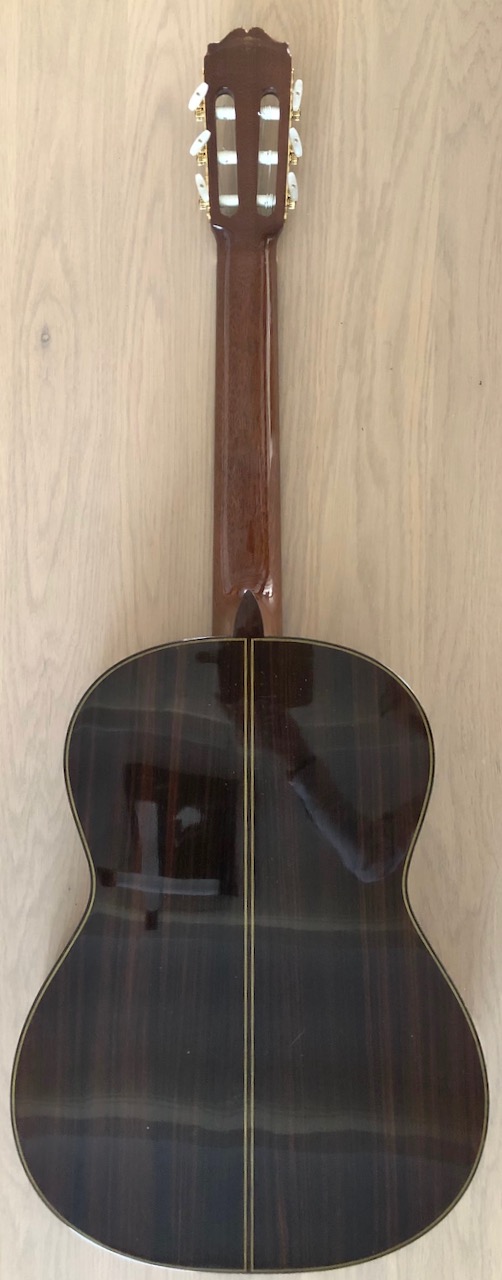
Het leek wel mode te zijn in Japan om het achterblad van 
een dunne vernislaag te voorzien in de klankkast. We treffen 
dit ook aan bij de Masaru Kohno, Sakurai, Juan Orozco en 
de Tama modellen uit die tijd. Een duidelijke reden daarvoor 
heb ik nooit kunnen vinden. Helderder klankresultaat?


De randinleg lijkt gekopieerd te zijn van de high end 
Kohno gitaren maar gezien de verschillende gitaren die 
af en toe aangetroffen worden zou een derde partij hier 
wel eens verantwoordelijk voor kunnen zijn geweest.


Ook het brugblok is van versiering voorzien, wellicht toch
meer een keuze van de mensen in Azie. Een andere smaak
en soms een beetje "over the top". Model 20 heeft deze
randinleg ook maar is voorzien van Braziliaans palissander
voor de zij en achterkant van de klankkast.


Nog beter te zien is de randinleg op deze foto en je kunt
hem zelfs beter bestuderen door op de foto te klikken.
Opmerkelijk bij dit instrument is de bespeelbaarheid nog
even los van het mooie geluid. Die is erg nauwkeurig
afgesteld. Het geluid is niet vergelijkbaar met de Kohno,
Sakurai en Orozco gitaren die voor de wereldmarkt ge-
produceert zijn. Het geluid is wat sprankelender en
heeft niet dat robuuste wat de eerste 3 hebben.
De andere kant is dat de levendigheid in de toon
een sterk punt is van deze gitaren. Toch lijkt de onder-
steuning van het laag vanuit de laagste frequenties
te komen, een soort van "voelbaar" laag.

woensdag 2 april 2025

Union Musical Espanola (Editores ANTES CASA) Labelled Guitar / Juan Estruch "Lady Guitar" (appr. 1920 / 1930)


A bit odd to start with a label as this is not a luthiers' 
label to our believe but most likely a guitar and other
musical accessoires supplier who had these instruments 
built elsewhere. Union Musicales Espanola had their
shops in different Spanish cities. Price: € 1250,-


Not a well known headstock for me but some details might
point to a Barcelona based luthier: The Juan Estruch company.
Recently I stumbled onto a 1970 guitar with the same headstock.


About the age of this guitar one can conclude that the later
ugly polyurethane finish is not present on the soundboard 
but is there on the neck, sides and back.


In the lower left there is some damage on the back and
after a good night sleep I decided to make some inserts 
for the cracks there. As it has to be levelled afterwards
the back as a whole will be refinished.


The yellow, red and green bindings are typical for Estruch
so possibly another Juan Estruch model. Contact with the
Estruch company indeed learnt that we are dealing with
a genuine Juan Estruch, one of the oldest guitar companies
in Spain though there are no "Estruch" named luthiers at
work anymore in the factory nowadays. Another luthier 
most likely bought the name and went on. On the other
hand, several luthiers learnt their craft at the Estruch
workforce among them Jose Grau, Jose Farre, Manuel
Condal and Antonio Picado. Also the later Antigua Casa
Gol is one of them. Closely related to the Estruch 
company is the Taurus Workforce. So a lot of different
luthiers could have been responsible for the building
of this guitar. Scale: 645 mm.


This headform resembles the much copied Ignacio Fleta
head but not exactly. That might give more direction towards
the luthier who constructed this guitar. But on the other hand
several details were more than often copied especially by the 
luthiers from Barcelona who worked for Estruch. The multi 
coloured bindings, Estruch is known for. Inlay in the bridge 
and even rosettes often were made by independent factories 
who supplied several luthiers in their country.

Nice clean rollers and refreshed frets. Alass this guitar 
has to be refretted as the neck is showing a serious backbow
which I have never found on a classical guitar until now!
And the only way to make a proper correction is to treat
the fingerboard by shaving it. In a most worst case the
fingerboard could have been replaced after having lined
out the neck. Most of the time not necessary.


A nice rosette and a spruce soundboard that is "crack" free.


And a matching inlay in the string tie block.


Fustero tuners that are in good condition. The axe holders
are clinched onto the base plate which is proof of superior
quality. Tuners like these alone will fetch more than 200
Euro's for one complete set.


Some spots on the outer neckblock but nothing fundamental.


In fact the case might give an idea about the age of this
guitar. Anyway a lot to be investigated still but a start
has been made by judging its' sound: Someone hightened
the bridgebone by putting some paper under the bridge
bone. A disaster for a good sound. Moreover the bridge-
bone was broken but that has been solved already.
I don't know the brand of strings but to my opinion
this guitar will sound even better with Savarez Corum.
The volume it can provide is already there now!


Here the label on the inside of the case is presented. I
recently came across exactly the same case around a 
guitar (and belonging to that one) from the early sixties
of the past age. Also cases that belong to an instrument
can give a confirmation of the age of an instrument.


Another typical move on the Concerto series of Estruch 
was the use of an ebony veneer layer on the outer heel.
And the multi coloured bindings of course. A short
E-mail contact between the Estruch company and me
confirmed my thoughts about the origin: Juan Estruch.


Here the facade of the UME shop in Girona is presented.
We were curious to learn what they could tell about a part of 
the history of this company. The guy in charge wasn't very 
helpful. "All those UME labelled guitars of the past are
crap" was all he stated. I showed him some pictures of the
this high end Estruch guitar but he wasn't convinced at all.
That made me think that you always have to understand
who is the person in front of you. He acted completely
wrong and what is more, quite unfriendly. A few days 
before visiting Girona we visited the workshop of Antonio
Picado and that meeting was quite the opposite!


Juan Estruch: Lady guitar (appr. 1920 / 1930)


With a scale of only 615 mm we can call it a "ladies guitar".
These smaller guitars were built by several companies and
can be found with different labels. More about that later.
Having worked on this guitar I presume it to be quite a bit
older, most likely around 1920 / 1930 when this Estruch 
label was used for the first time. A lot of workers from the
Salvador Ibanez company started for themselves but kept
building a bit in the Ibanez tradition. Therefore it remains
difficult where exactly these guitars were produced. I can
mention several names here though mostly from Valencia:
Jose Parres, Juan Ponce, Andres Marin and others, not
always workers for the Salvador Ibanez company. I have
3 guitars that in fact are a bit look-a-likes, very simple
in building structure but they all sound surprisingly well.


In fact these guitars are simply built in all aspects as you 
can see on the rosette around the soundhole here. No fan
bracing present in these ones, only the so called ladder 
bracing. AČ™ this soundboard needed to be sanded and thus
was "ending" thinner, I figured it the best to give it a 3
piece fan bracing. To bring down the string height together
with shaving off the fingerboard towards the head. I made
a twelve hole bridge as can be seen here. Price: 350,-


Some other changes have been added, sometimes for
constructional reasons. For example, the center inlay
wasn't there but when you remove a back, the plantilla
of a guitar changes and besides that it is an opportunity 
to built in a neck reset. The upper and lower bout then
are widening a bit so you are in need of some extra
back material or a new back but the wood of this back 
is so specially figured I've kept that of course.


Besides sanding the whole guitar and do some regluing
of the several parts, I've tried to make the neck as clean
as possible but several paint traces simply were too deep.
Then it is better to repaint the neck as a whole. The rest
of this guitar has been French polished.


The front of the head has been sanded as well a bit but
polishing it further did the job. Cleaning the tuners was
a next step as was making a new knob. A bit strange on
this guitar are the individual machine heads that are 
marked as well. In fact they were a bit sloppy mounted
as you ca see on the uneven holes for the metal rollers
left and right. They still work very smoothly.


Of course new frets and a new topnut as well. The 
fingerboard has been stained to a dark brown colour.
I always use Clou powder to make these stains on
a water base and I add a bit of grey to get that
old look these guitars need to be equipped with.


Resoldering the axe holder for the G string was needed
and I was simply surprised by the material of the other 
knobs that still are like new though the holes in the
head of this guitar are proving that these tuners were
there from the beginning.


Slightly bowed here and there but being that old
it is better not to try to remodel that as the axe
holders were already vulnerable.