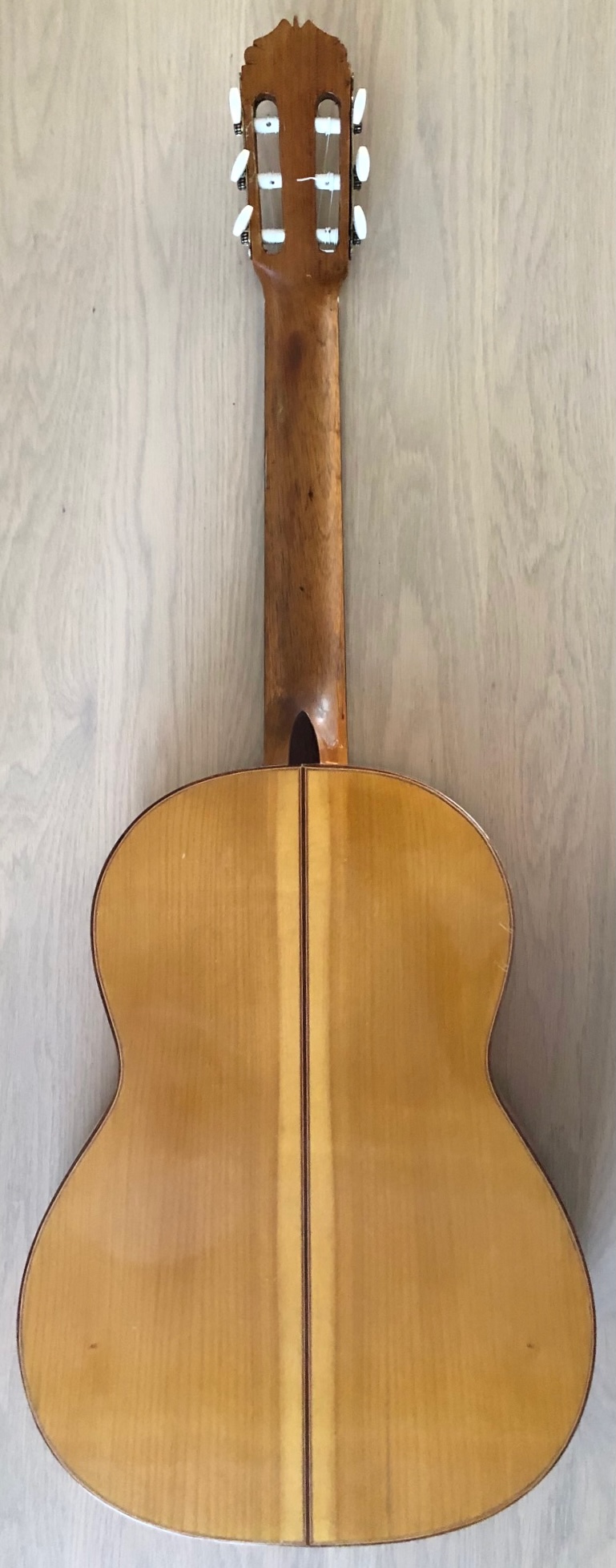
A Telesforo Julve that had an intensive restoration process.
As the sound was very promising already, I figured it should
be worth it. All parts have been French polished after a good
cleaning job. However, as the original lacquer had disappeared
at certain spots it became very difficult to have an even
coloured top after the polishing process. I make my own so
called "wood brightener" and as it is also called oxalic acid
solution I made it with oxalic acid and water. Then you are
able to determine the mix with water yourself. It was needed
several times.
The final result after this intensive restoration process is
a well playable and really surprising sounding instrument.
Scale 646 mm. Width of topnut 51 mm. Action on the
twelfth fret: 3 mm string 1 and 4 mm string 6.
The price now is 500 Euro's.

Much better now and after all it is not a new guitar
and thus doesn't have to be like that.

Walnut really can be a beautiful wood in itself.
Anyway I like the back and the way it is figured.
And the French polish technique adds a lot to
the beauty of the final result.

Refretting is a must as the filed copper frets weren't in
a good condition anymore and moreover doesn't give
a great convience of playing. A new topnut made out
of bone, more carefully spaced enhances playability
as well. The thinning of the neck did the rest!


And most of the time the heads and sleeves for the rollers
haven't been done very symmetrically. As a new refinish
job is necessary, why not make corrections on those
as well and of course a cleaning job for the tuners.

This was were this guitar shines: No cracks anywhere,
a straight neck, good sound and beautiful figured walnut
sides and back. A small spot due to the expansion of a
transverse bar has been cured from the inside by placing
a glue block on that particular spot.

This label picture has been taken through the sound
hole. A better picture you can find here beyond where
I'm talking about the restoration process
For those who are interested in the restoration process:

The back had to be lifted off as some glue work wasn't
proper anymore. A check on all the details inside can
be done then as well.

Fairly easy to remove the back but you have to be prudent
when it comes to removing the back from the inner heel
tongue. Somewhat a little help from the inside of the sound
box is needed but all in all successful!

I've included another picture of the label as here the label
can be presented complete. The telephone number on the
right (under the address) is pointing towards a guitar
made between 1945 and 1957 as is the address.

A good shot at the lower bout that makes clear the sound
board has been built up out of three parts. This has been done
quite often and lets' remember: Even Antonio de Torres made
some of his guitars with a soundboard out of 3 pieces. On the
lower right you can see through as a piece of the edge inlay is
missing. No bracing in this guitar but I figured it to be a good
experiment to give this guitar a 3 piece fan bracing in the style
of Telesforo Julve. The reason for that is that you have to
remove the old lacquer and also a bit of the wood from the
soundboard to remove excessive trays of rude playing. A
thinner soundboard asks for a light bracing.

The heel that is partly made out of the softer spruce.
The individual glue blocks are placed quite wide from
each other. It is known that higher end guitars have
them more close to each other.

So I've decided to place extra glue blocks in between.
I've coloured them later but in fact not necessary. The
existing glue blocks have all been checked and reglued
when necessary, together with the transverse bars.

Here the new fan bracing is visible. Of course the
additional advantage is that the part of the soundboard
under strength and tension of the strings better with-
stands those forces. The extra glue blocks will enhance
the contact of the top with the rest of the guitar.

With the back off it became clear that the glue work on
the braces wasn't great anymore. I removed the braces and
cleaned the surfaces of course before regluing. As I wanted
to replace the back in the Spanish way these braces are glued
to the sides first but at the proper hight so the back makes
contact along the entire braces.

Of course it could also be a method to glue the
transverse bars to the back first but here I only
placed them in order to make a picture of it.

Here the body is ready to receive its' back again. It is
necessary to reglue them to the dimensions of the back.
Therefore careful measuring is a must during this process.

The two halves of which a back exists, were held
together with cleats though these newly placed
strips work a lot better. The better guitars all have
this kind of "protection' to prevent unwanted
splits. The grain of the wood of these strips
should be on 90 degrees with the back pieces.

I've coloured the fingerboard the way it has to be.
(The cheaper models have a black painted fingerboard)
The copper frets that are originally mounted in these
guitars are always filed but never rounded afterwards
which makes these guitars a bit uncomfortable to play.
It was customary in Valencia in those days.
Moreover, this neck was way too thick so I remodelled
the neck as well as I was planning to French polish
the whole guitar. And necks aren't that difficult to do.

As this guitar obviously wasn't a concert guitar and relatively
cheap, the owner(s) weren't that careful with it as I often see.
So a new back plate on the head covers the marks incurred
during its' lifetime up till now.

A good cleaning of the tuners was another must and the
axes being made with metal rollers makes this guitar
also produced from before the early sixties. Wether if
the lack of the two inlays on the bridge tie block is
pointing towards an immediately after second world
war model I do not dare to say but it certainly could
be the case as there was a shortage of about everything
after the civil war followed by the second world
war (That is well known in Spain.)
People may wonder wether if it has been worth all that
trouble but these guitars find themselves in a growing
popularity and for a reason. They simple sound good.
Let's look at the price list of what has been done:
New fretwork: At least 200 Euro's Cleaning.the
tuners: 30 Euro's. Regluing bars and glue blocks while
lifting the back: over 200 Euro's and finally French
polishing the whole guitar: More than 200 Euro's.
Therefore the final price of 500 Euro's is more
than reasonable. I haven't even mentioned the
reshaping of the head and thickness of the neck!
Problems with a topnut:
I recently came across a malfunctioning topnut though it was
not made out of plastic. I made another one out of bone but
probably one of the slots for the B string wasn't enough
"decending" towards the tuners. Thus the contact of the string
on the topnut was on the wrong point: Not near the finger-
board but on the other side. That made the open B string too
low but once properly tuned it is logical then that the fretted
notes are too sharp. And you know, when you have to find out
where the problem lies you're experimenting at first a lot
while the solution is fairly simple. The string kept on sounding
bad, a bit muffled and not in a clear way anyway, As the other
strings sounded good it puzzled me again. Mounting another
B string, still the same result. Now you have to be aware that
bone is a natural material, hard enough to serve as a topnut
but it is always possible that certain parts are softer and have
less density. Normally you do not expect that but another top-
nut proved that. A crystal clear sound again out of the B- string.
Before you're searching for intonation problems, the bridge
bone at first comes to mind: Is there enough compensation?
And where is the contact area as when it is too wide the
string will not give its' best sound. It can even give a kind
of sitar like tone when the contact area is near the bottom
of the guitar though I sometimes provide my guitars with
such a bridge bone in order to have enough compensation
and as a result a perfect octave pitch.
Formerly the "Zero" fret was a good solution though you
hardly will encounter them anymore. But it would have
solved any of the problems described here above but in
the tradition of the classical guitar it is not the way to go.
Vicente Tatay Tomás (Intermediate model)


Presente here is a pre 1973 (according to the label) model
B-108. At a certain period Vicente Tatay Tomas provided
his guitars with a small sticker on the back of the head.
Why would this be an intermediate model? There are some
details that are pointing towards that as e.g. the extended
fingerboard, the polished frets instead of the roughly filed
frets on the entry level guitars. Furthermore a bigger scale
(655 mm as opposed to the 645 mm the entry level guitars
are constructed with.) A larger body and a 5 fan braced
soundboard completes this guitar. Price 250 Euro's


The head, as so often with those "cheaper" guitars a bit roughly
treated by placing the guitar against a wall. Also a reason to
make corrections on the head and reglue loose parts. The top-
nut already has been replaced but needs a final adjustment.

A nice rosette and a narrow grained top on this one. The
extended fingerboard for demanding pieces can be studied
here. The polished frets that gives a smoother playing result
have been extra treated in the whole process.

Maybe not that visible but this guitar is occupied with a
"see through" scratchplate. Could it be ment as a flamenco
guitar? Question is also the wood of the bridge. It has
been finished in a way you would expect genuine ebony.
A new bridgebone was a must. Adjusted to reach a
nice octave pitch. Exact dimensions are: Length: 493 mm
Upper bout: 380 mm Waiste: 235 mm Lower bout: 375 mm.
The depth varies from 98 mm to 100 mm.

The small damage ob the right of the upper wing has
been sufficiently treated. Most likely just some surface
damage and not a crack. Even when it would be a
crack it is cannot go that much further and moreover
it is in an area where the tone of a guitar isn't made.
Yet I always treat these damages as if they were
cracks, so trying to press in some glue for stability.

A compensated bridge already as opposed to the entry level
guitars from Valencia in those earlier times. They often placed
the whole bridge under an angle as also was customary at the
beginning of the past age.
The larger body on this model results in a good and rich
bass response though the higher notes are present as well
and not at all thin sounding. I treated the whole guitar
with NIKCO, a polishing compound. The dirt that came
off was astonishing. Maybe the smoke environment of
those former days could be the reason.

To ensure a good angle over the bridgebone for now and
in the near future, a 12 hole bridge has been installed.

This is the pre 1973 label (according to Ton Bogaard) with
the guitar neck pointing to the right. On the later labels the
guitarneck is pointing to the left. The extra addition Vitato
might raise some questions. Wether if it is a sign of more
quality I do not know. Anyway, it stands for Vi(cente)
Ta(tay) To(mas) from Valencia of course.

The back still is in a great condition with no cracks and that
counts for the soundboard as well. At first the choice of wood
for sides and back puzzled me a bit: Is it walnut? At least
the sides are obviously but on both sides and back the inner
layer has been made out of mahogany, not customary in
earlier times.

The tuners, most likely from RAED are quite mediocre.
On request I can deliver much better tuners that will do
more justice to the quality of this guitar.

These tuners are a good replacement. They are older Tatay
Tomas Tuners from probably end of the fifties / early sixties.
From a guitar that wasn't original anymore and that one
received higher end tuners. But the axe holders on these
tuners are clinched to the plate and can be regarded as
an upgrade. Often guitar builders held on to the same
model numbering system but economized on the mate-
rials used, sometimes wood, sometimes tuners.

Maybe kept in the closet for years? There are hardly any
traces on the frets that would betray a lot of playing. And
bides a better bridgebone, also a bone topnut with a
better spacing.
Vicente Tatay Tomas B-108


This guitar suffered a lot from moisture problems, most
likely stored in a wrong way. It was a challenge to bring
it back to a playable condition and do some experiments
with it at the same time. A wonderful sound is coming
out of this one in the end. Possibly due to thinning the
soundboard at the edges and glueing braces on the sides?
Pictures from "Before and After".


I've managed to remove the ugly spots on sides and back
but did't succeed entirely on the soundboard itself. This
guitar has its' history and I left it the way it was on that
particular spot.

And even worse on the inside!

On these spots only oxalic water treatment will work
but most of the time better on the denser wood species.

"Ready for the garbage bin?" someone told me...

Same spot: A lot better! also the lining on the left
has been restored and an ebony inlay in the bottom.

These places have been cured sufficiently! Here
everything came loose but wasn't cracked.

The label in this guitar: also from before 1973.

And not only on the sides. I'm glad I gave it a try.
I'm playing this one daily in spite of having concert
guitars that are valued several thousands of Euro's.

The moisture damage seems to be better cured on the
hardwood parts. The soundboard damage remains visible.
Another lesson for the near future!