Zoeken in deze blog

zondag 12 januari 2025

Admira "Artista:" and "Soledad" / Melchor Rodriguez guitar (Estudio)

Admira "Artista".


A lot can be said about the Admira guitars but they survived 
the "Japanese" invasion of the seventies / eighties of the past 
age. I remember them being on holidays in Spain near the 
coast around 1970. We were in the race for some Spanish 
guitars back then. But most of the Spanish guitars offered
in shops along the Costa Brava were sloppy made, that is
to say: In our price tag back then.... We bought one finally 
but later visited a city out of the coast were they offered 
us an Admira guitar. Much more solidly made but with a
veneered top. Later we discovered the German firm Keller
was responsible for the production of these guitars.
Already then they looked good.


This Artista has a solid top, solid sides but a veneered back.
Moreover the neck has been equipped with an ebony fingerboard.
Very well made anyway and the German touch still can be 
recognized even after all those years! As always the same
grade models do not have to be exactly the same as the newer
made ones. That the sides on this guitar are solid is a strange 
move to opinion. I removed a poorly added Shadow under
saddle pick up and removed a cable holder on the top as
well. A good and real bone example is mounted now.


The "Soledad" branded guitar here above is another story.
Most likely N.O.S. which means "New Old Stock". It simply
is a new instrument. No damages, no fret wear and all
solidly built. Comes with a hardfoam case: Price € 525


The label, although the "Soledad" is out of production.
It often goes in two different ways. Either a lutherie holds
on to the model name or number but changes production
after time in a way that materials sometimes are less.
Discontinuing a model means "creating" a new model
with about the same specs but a higher price. You simply
have to be aware of that. After all it remains business.


Good straight grained back and sides which minimizes
cracks in the future opposed to wildly figured and backs 
that indeed have some more appealing looks.


I've installed a 12 hole bridge on this one in order to
get a better angle over the bridgebone. It has a positive
effect on the tone and sustain.


A nice rosette, good fretwork and in fact an almost 
flawless glued bracing in the interior of these guitars.


Good working tuners as well.


And a securely adjusted topnut.


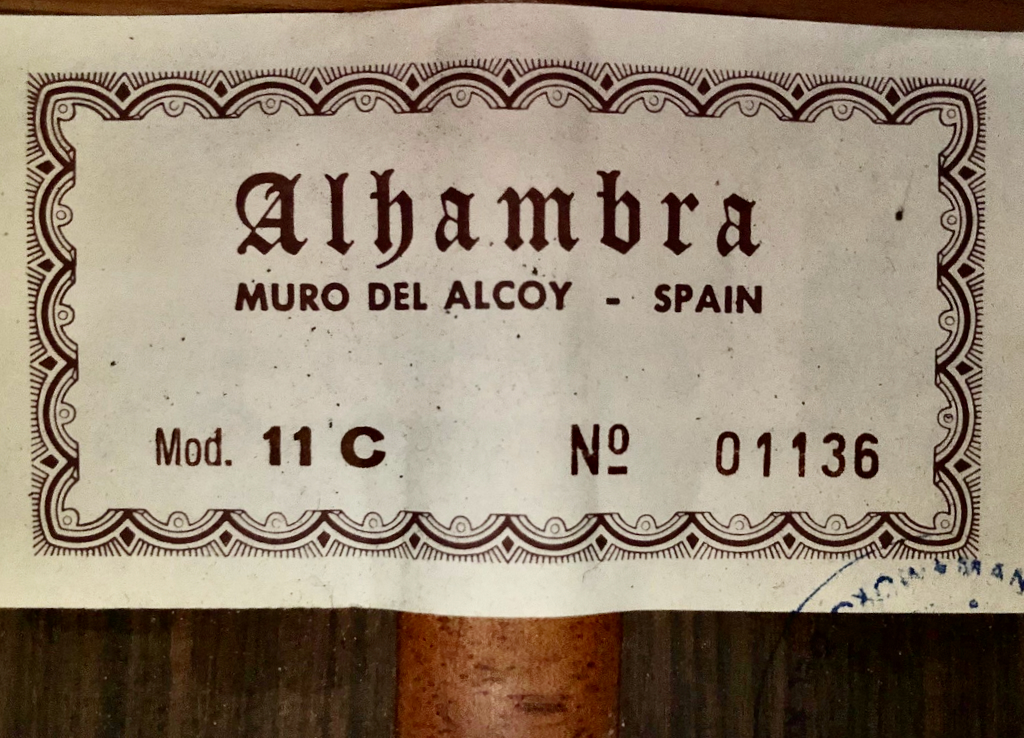
As always: Their Admira sticker stating that 
the guitar is equipped with a solid top.


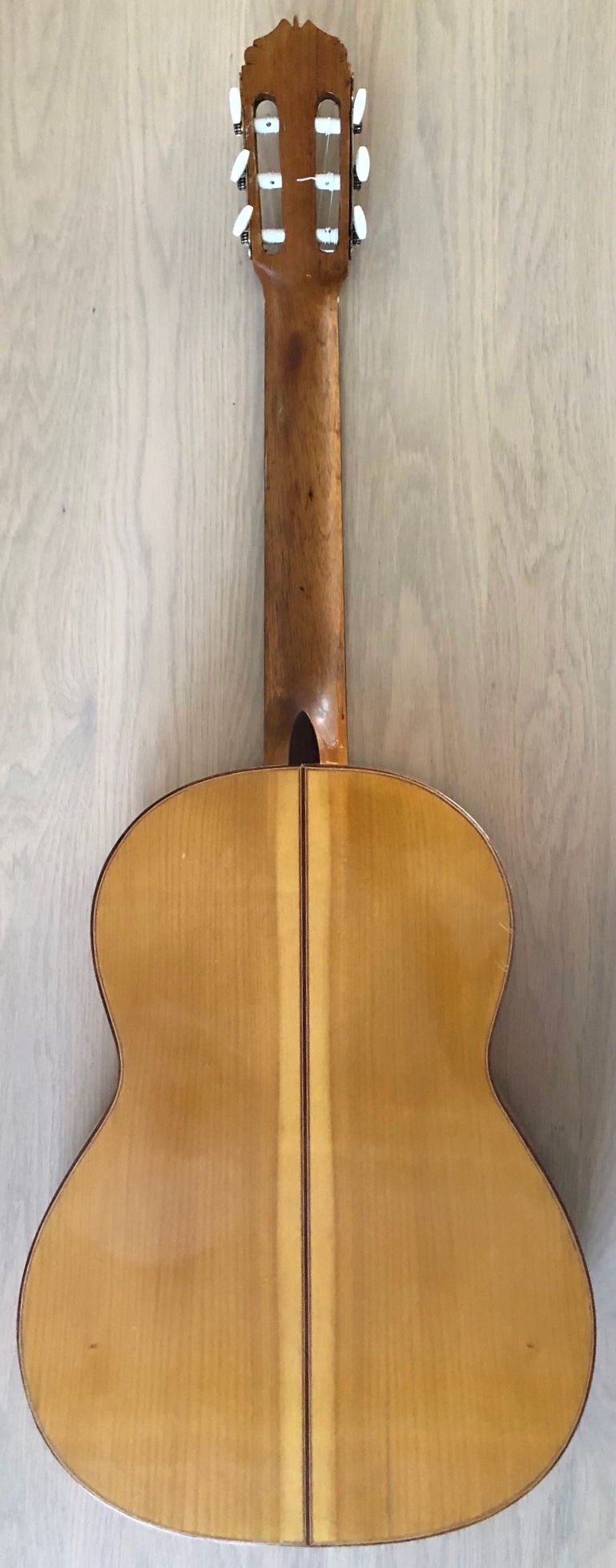
Melchor Rodriguez guitar


A guitar that surprised me a lot sound wise. It is in fact 
a bit of a Jose Ramirez 1A concert guitar clone: The
soundboard has been equipped with a 7 fan bracing
and the small individual hardwood glue blocks simply
do resemble the Ramirez construction a lot. The great
concert guitar player and composer Jose Luis Merlin
also plays a Melchor Rodriguez "Merlin" model and 
the two even became friends. Melchor Rodriguez has 
retired now though the two still have regular contact.


 Being a quality instrument, the addition "Estudio" on the
label surprised me as this guitar can compete with other
high level instruments. SOLD


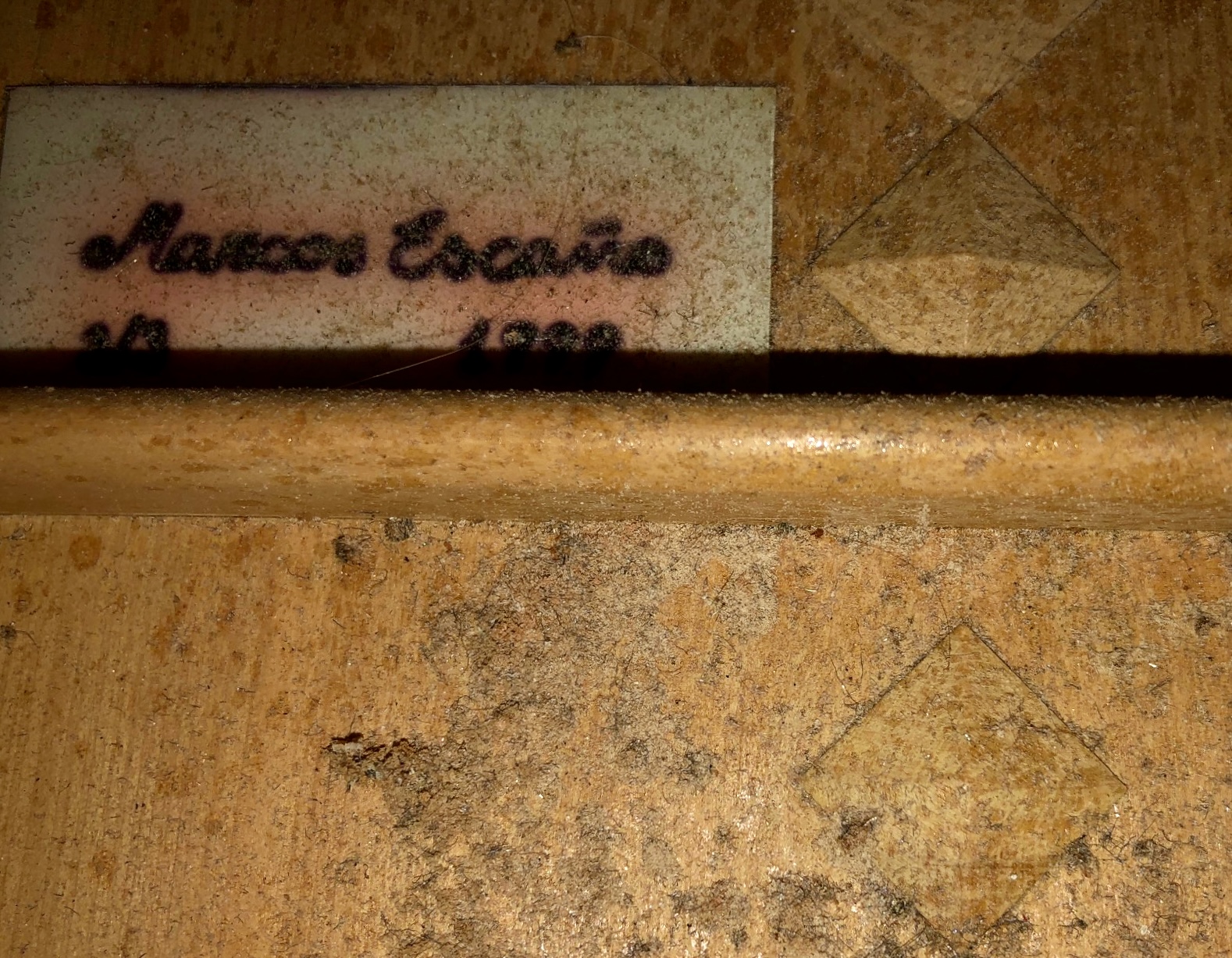
Therefore I also made this picture where you can observe 
the beautiful rounded inner heel. Also the way it has been 
done in the Jose Ramirez clase 1A guitars. In fact every
detail of the inner work shows a high standard!


The body has its' traces of normal use but being almost 
50 years old that is understandable. The sides have been
strengthened with extra braces the way Jose Ramirez
did in his 1A models as well. The damage on the lower
bout on the right in fact was only lacquer loss but the
former owner kept on using the guitar without protecting
the bare wood. As a result that became dirty. I cleaned
that spot and colored it matching with the rest of the
soundboard. I used a water based stain for it: CLOU
You can get it in all sorts of colors in powder.


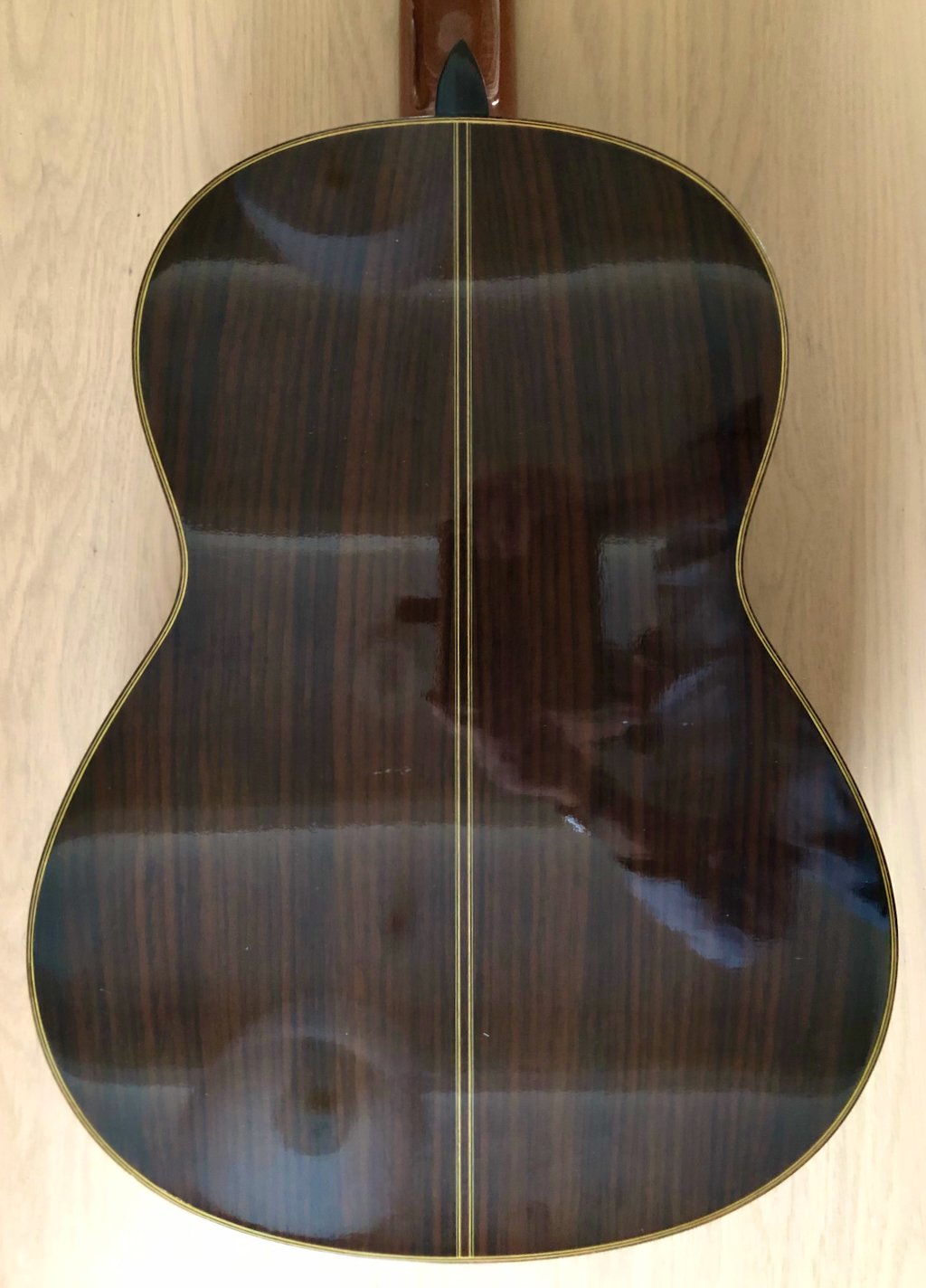
The back is still in a remarkable shape although I might
give it an extra layer of varnish to make it like new.


A much fresher look and it gives more cosmetical value to
this guitar. Rosewood can be lacquered and polished quite 
easily. The problem is there most of the time when you are
varnishing the bare wood as it contains often oil residues 
that are slowing down the hardening of the lacquer.


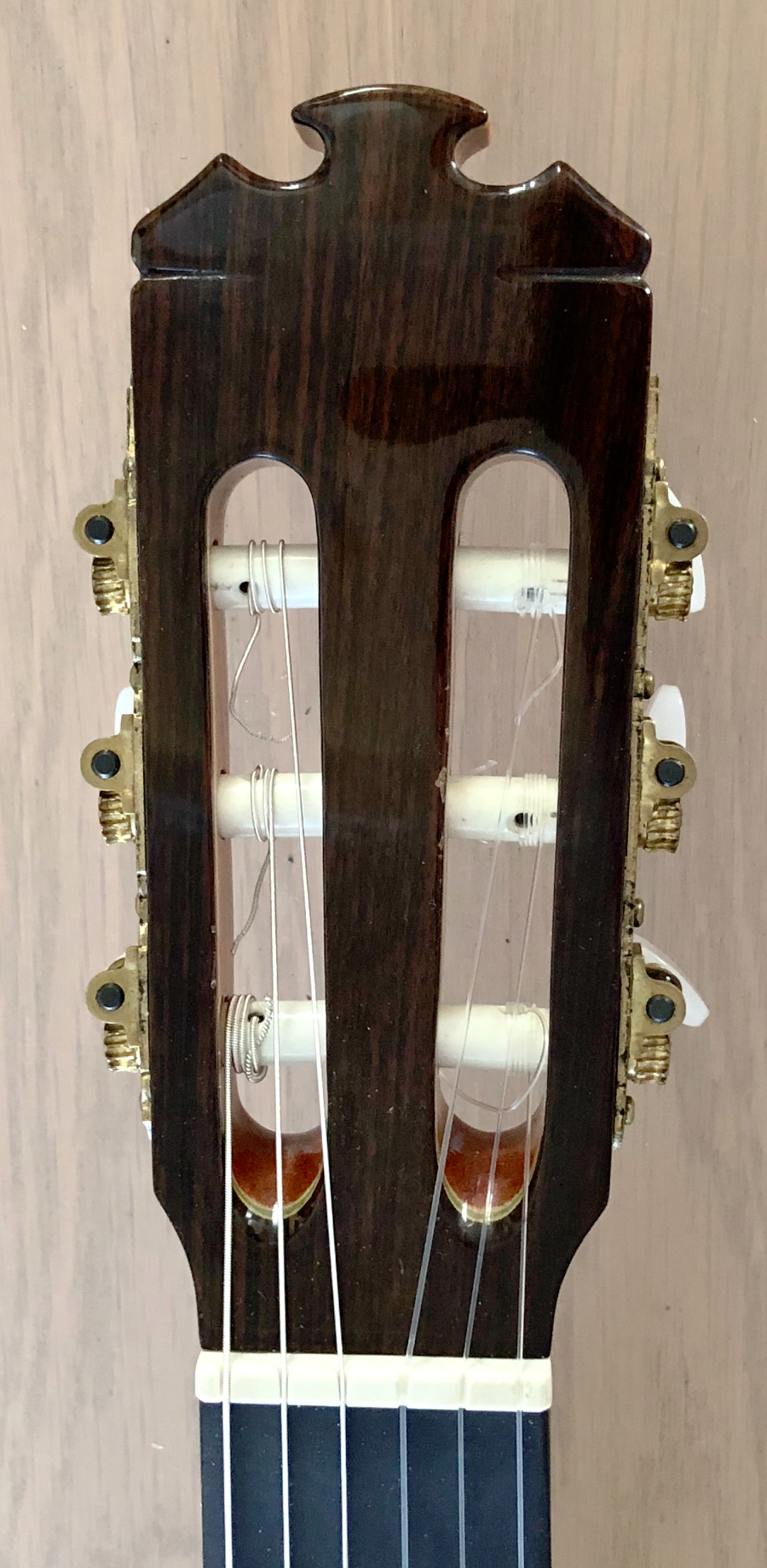
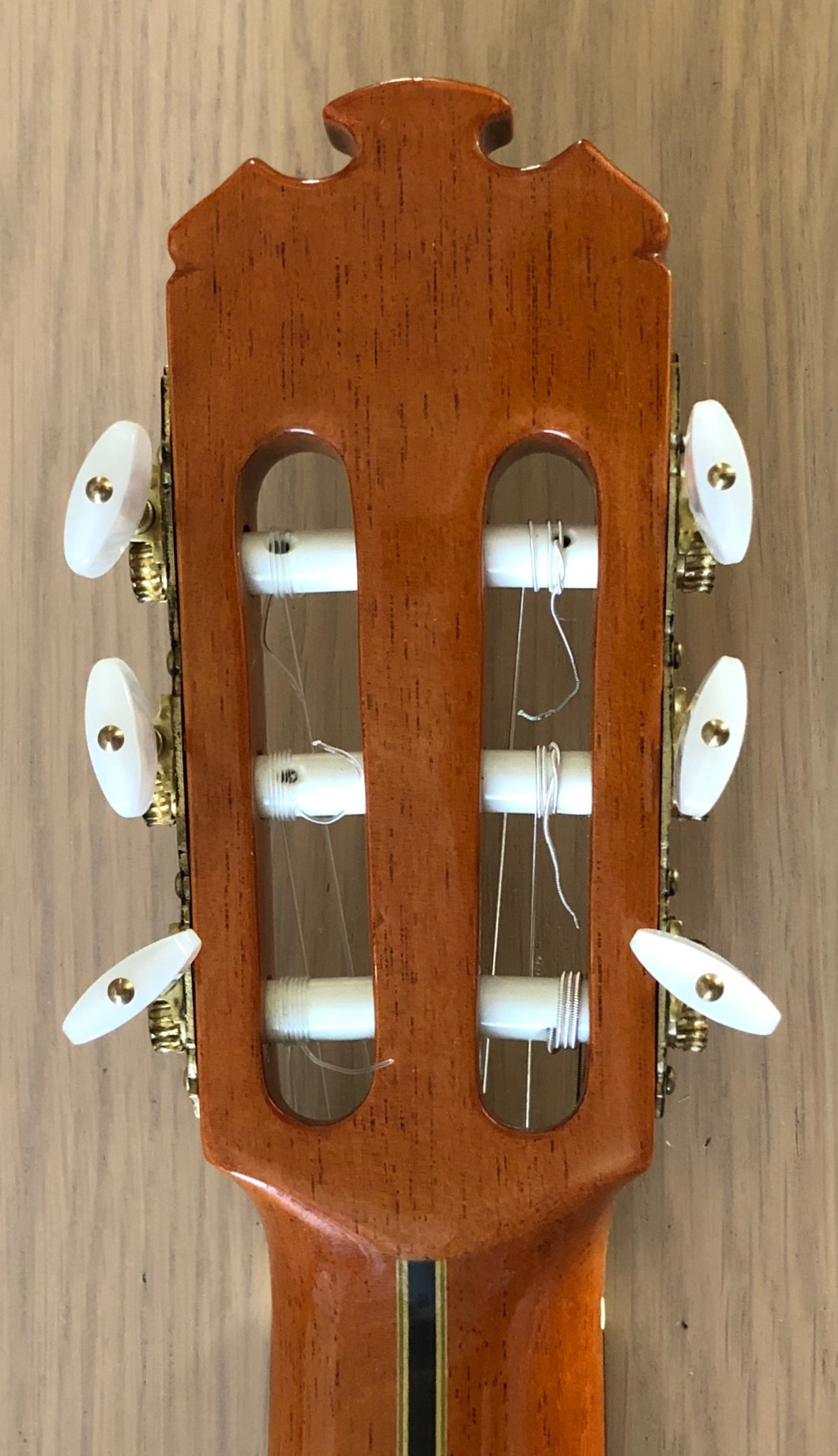
As with a lot of other Spanish makers the luthiers sometimes 
stick to the use of the same model name or number while
changing several things regarding the components. Here the
gold coloured tuners can be seen while on other Estudio
models they appear to be silver coloured. I've seen about
the same tuners on the Melchor Rodriguez Grand Concerto
guitars, a bit surprising as the axe holders were also bowed 
out of the base plate on those tuners. Another Madrid based
luthier, Vicente Perez Camacho is using exactly the same
tuners on a guitar I have in my collection.


Good fretwork and a very nicely executed rosette,


And a bridge where the string tie block has been
provided with harder edges to prevent damages.

dinsdag 7 januari 2025

Sadao Yairi gitaar model 800 (1976)


Hier een mooie gitaar uit de ateliers van Sadao Yairi. Ik ga
er niet van uit dat hij de gitaren allemaal zelf bouwde en dat 
geldt dan ook voor de hoger geclassificeerde gitaren. De S. 
Yairi gitaren werden eigenlijk maar in beperkte mate met
palissander voor zij- en achterkant uitgevoerd, iets wat je
bij de duurdere series toch zeker zou verwachten, zeker in 
de zeventiger jaren. Dat de Jose Ramirez Clase 1A gitaren 
model hebben gestaan voor deze modellen is evident. 

Deze gitaar is in prima staat behoudens wat kleine gebruiks-
sporen en wellicht wat deukjes op de hals van capo gebruik. 
Wordt verkocht in zijn originele snake skin koffer en de prijs 
houd ik aan de ondergrens voor wat ze momenteel doen. 
Speelt lekker licht en de gitaar is helemaal afgesteld voor 
optimaal spelplezier. Prijs: 700 Euro.


De gitaar is voorzien van een prachtige rozet en ook het binnenwerk 
is keurig verzorgd bij deze gitaar. Het bovenblad is voorzien van
het traditionele 7 delige waaier patroon. Voor het bovenblad is 
massief fichten (sparrenhout) gebruikt. Fijngenerfd. E.e.a. zorgt
voor een mooie balans qua geluidssterkte tussen de lage en de
hoge snaren. Een mooie ronde en volle toon mag bij dit instrument 
verwacht worden. Dat is er dan ook en de ebben toets geeft een
extra luxe uitstraling aan deze gitaar. Scale is 655 mm. Breedte 
van de topkam is 53 mm. Eigen frequentie van de klankkast is 
110 Herz. Niet prominent aanwezig.


Door op de afbeelding te klikken krijg je de rozet foto nog
eens extra vergroot. Op deze foto moeten de frets nog even 
opgefrist worden maar dat zal ik voor verkoop zeker nog 
doen. Het klassieke label siert de gitaar nog eens extra.


Geen speelsporen waar ze vaak wel te zien zijn. Octaaf
zuiverheid is prima.


En hier alle informatie: Bouwjaar en type nummer.
De signatuur wordt zeer waarschijnlijk gewoon mee-
gedrukt met de rest van het label.


Luxe kam welke nog eens mooi verstevigd is aan de 
randen van het snarenblok. Zit ook prima vast nog.


Hier kunt U een evt. beschadiging nader bekijken. Geen
hindernis bij het spelen wat mij betreft maar laat e.e.a. maar
duidelijk zijn: Midden foto links op de hals.


Mooie achterkant met hoegenaamd geen krassen. Mooi
is natuurlijk de centrale strip als extra ornament.


Ook de achterkant van de kop vertoont geen ruwe
beschadigingen tengevolge van het tegen de muur 
zetten van de gitaar.


Tot aan de onderkant wordt de extra versiering op deze gitaar
doorgevoerd maar gelukkig ook weer niet al te overdadig.


De frets zijn nog in prima staat. Wel een paar kuiltjes in 
het toetshout vanwege het spelen met te lange nagels.


Een wat dieper putje in het bovenblad dat netjes opgevuld
is. Beschadigingen kunnen lelijke sporen achterlaten als
er vuil in komt.


De inmiddels weer netjes opgefriste frets.


De originele snake skin koffer die er bij geleverd kon
worden indien gewenst. Zit nu bij de koop inbegrepen.

\

Toch nog een gaaf plaatje na bijna 50 jaar!


Apart is dan weer wel de toepassing van verschillende mechanieken 
die je op hetzelfde model van S. Yairi aantreft. Vaak ook niet goud-
kleurig. Ze werken overigens uitstekend. De goudkleurige zitten op
deze gitaar en zijn uiteraard weer goed gesmeerd.

donderdag 26 december 2024

Oscar Teller 8/A Guitar (1971) / Oskar Teller (Tellson) 7/P (1963)


Presented here is a completely relaquered Oscar Teller 8/A
The prefix "A" stands for ahorn, probably better known as
maple. As maple was readily available in those days this
model, executed in maple sides and back, was cheaper than
its' counterpart, the model 8/P in rosewood. Nowadays it
would have been different as the lighter hardwoods are
quite popular at this moment. But let's not forget also
Antonio de Torres already used maple for his premium
models in the 19th century and so did several French
guitar builders.


A closer look at the back is possible just by clicking on these pictures.
The scale is 645 mm and the bodies' own frequency is around the note 
G# which means 104 Herz. Width of the topnut 52 mm. The intonation 
is really good. Due to some top cracks the price would be 1/3 of the 
price what this guitar would be new: 700 Euro's. The 8/P made by 
Wolfgang Teller (still in business) now costs € 3000,- As for the 
cracks: Everything is repaired and stable now.


The top has been French polished but keep in mind that not
all damages can be treated as then you are obliged to sand down
the soundboard. The top will be thinned then and is more prone 
to deformations and might even possibly collapse.


And its' label that says Model Nr. 8 / A Anno 1971.
Oscar Teller wasn't alive at that time anymore but
his son Horst kept the same label and name.


Hardly any fretwear. Someone must have did a job not that long ago.


The tuners were lost but these ones do the job really well.


The head often is a victim of damages from setting the guitar 
against a stone wall or knocking it against that wall. As the
back of the head was severely damaged I figured it would be 
nice to add a maple back plate the way later often has been
done by this company and its' builders. Moreover, maple is
much harder than the most of the time used cedar wood for
the necks.


The rosettes from those times on their premium guitars
were immediately recognizable. As for sound: the Teller
guitars tend to sound a bit dark and with this maple for
sides and back the sound is clearer and perfect to my
opinion. Anyway, I like it even better compared to the
rosewood version I have. On the right you can observe
the older rosette on a 1963 model 7/P.


Oskar Teller 7/P 1963


No, not a mistake in the announcement of this guitar.
Before the more common labels, the name Oskar was 
spelled with the prefix "K". Moreover, the later guitars
most of the time were offered without the addition
"Tellson" as that name merely was used for the steel-
strings and jazz (f-holed) models. Horst was at
the time already director of the company, due to
the untimely death of his father.


And here the rather "unique" Tellson - Oskar Teller
label. That states the guitar to be built in 1963. As I
already "stumbled" onto two model 8 Oscar Teller
guitars in the past, I figured I would give it a try. And
also regarding this model, some details have been
simplified during the timeline: Same model - less
elaborate details on these guitars. The back inlay
in the neck later was a single one as opposed to this
1963 model. In comparison to the 8 models, the tuners 
are also Rubners but executed in metal and not "gold"
From old pricelists and catalogues one should read 
8/P  and not 81P as sometimes is suggested.


This guitar was available in an auction house that is not 
specialized in musical instruments. Therefore a bargain 
can be had here and there. Remarkable remains that
damages such as a crack on the right below the bridge
hasn't been mentioned in the catalogue. Being an auction
online a lot of potential buyers maybe are not taking the
effort to visit the auction house in person but it is ob-
vious that it remains very important to do so.


Same as on the 8 models is the rich rosette and
the ebony bridge with the two plastic strips on
the edges of the string tie block though also the
inlay of the rosette has been changed, maybe
to speed up building processes?


On the front the two inlays recognizable on the 8 model 
is not present here. The double maple strip inlay in the 
neck disappeared later on the 7 models. As you can see
the axe holds are riveted onto the plate and the knobs
themselves are also clinched on the axes.


The rosewood used for the back and sides are showing 
a lot of similarities with the 8/P model. Question remains
wether if they have been using Brasilian rosewood for 
their top models back then.